What "Training Your Stress Response" Actually Means
"Training your stress response" means deliberately and repeatedly engaging your body's stress-and-recovery system, the hypothalamic-pituitary-adrenal (HPA) axis and the vagus nerve, so it returns to baseline faster after a stressor. It is different from "managing stress," which is about coping with a single moment. Training changes your baseline reactivity over weeks, not minutes.
Here's the mechanism in plain terms. When something stresses you, your hypothalamus signals your pituitary gland, which signals your adrenal glands to release cortisol. That's the HPA axis: a hormonal relay built to handle short bursts of real danger. The trouble starts when the relay stays switched on. Chronic, unresolved activation produces what researchers call allostatic load, the cumulative physical cost of staying in a stressed state too long. Allostasis is the opposite: the process of maintaining stability by actively adapting to change, rather than staying rigid or staying stuck on.
The other half of the system is the vagus nerve, the main pathway of your parasympathetic nervous system. Its strength, called vagal tone, determines how fast you come back down after a stressor. Vagal tone is measurable through heart rate variability (HRV): the tiny, healthy fluctuations between heartbeats. Higher HRV generally tracks with stronger vagal tone and faster recovery.
This distinction matters because most stress advice targets the moment, not the system. A walk around the block helps you feel calmer right now. It doesn't necessarily change how your HPA axis or vagus nerve behave next week. Training does. It's a skill built through repetition, the same way a resting heart rate drops after months of cardio training, not after one run. Cortisol rhythms follow the body's circadian clock, and unresolved stress compounds against that rhythm rather than resetting overnight, which is one reason consistency matters more than any single big effort. [8]
Set your expectations here: nothing in this guide works in one sitting. What follows is a realistic map of what does work and how long it actually takes, drawing on the same mechanism behind Pulsetto's clinical data.
Can You Actually Train Your Stress Response? What the Evidence Shows
Yes. A 2022 meta-analysis of 22 randomized controlled trials (2,876 participants) found digital resilience training produced moderate-to-large improvements in resilience (g = 0.54 to 1.09). [2] Animal and human studies on "stress inoculation," controlled exposure to mild, manageable stress, show the same pattern: measured doses of stress build tolerance to larger ones, provided recovery time is built in between doses.
Stress inoculation training (SIT) is the clinical term for a simple idea: intermittent exposure to mild, controlled stress builds your capacity to handle bigger stress later. It was originally developed for anxiety and PTSD treatment, and the underlying principle, small doses build tolerance, shows up across a much wider range of research. The mechanism is called hormesis: a small, controlled dose of a stressor strengthens the system, while a large, unrecovered dose damages it. Worth being honest here: a lot of the foundational hormesis research is preclinical, run in animal models rather than in people. [4] The human evidence is strongest for two specific applications: digital resilience training programs and HRV biofeedback, both of which have real randomized controlled trials behind them.
Two of those trials are worth naming directly. Students, healthcare workers, and general adult populations across 22 RCTs saw those resilience gains. [2] Nursing staff across 17 studies and 1,020 participants saw a moderate effect on resilience and wellbeing, though the reviewers rated the certainty of that evidence as low. [3] That caveat matters. These effect sizes are moderate, not miraculous, and no single study here proves any one technique works for every person.
What ties the effective methods together isn't one trick. It's a pattern: physiological regulation, controlled exposure, and cognitive reframing, each targeting a different layer of the stress-response system. The next section breaks down six methods with real evidence behind them. After that, a simple framework, the Three-Layer Stress Conditioning Model, ties them together into something you can actually follow in order. Pulsetto itself continues building on this evidence base through its own ongoing clinical trials.
Six Evidence-Based Methods to Train Your Stress Response

Six methods have real evidence behind them: paced-breathing HRV biofeedback, brief controlled cold exposure, structured exercise, cognitive reappraisal, vagus nerve stimulation, and social co-regulation. Each trains a different part of the stress-response system, and they compound: combining a physiological method (breathing or VNS) with a cognitive one (reappraisal) shows stronger effects than either alone in the training literature.
Each method below gets one concrete way to start. None of them require rebuilding your whole routine at once.
Paced Breathing and HRV Biofeedback
The technique itself is resonance-frequency breathing: slow, paced breaths at roughly six breaths per minute, the single most studied entry point here. HRV biofeedback is how you make that practice visible instead of taking it on faith. An app, a chest strap, or even a simple counted-breath pattern shows your heart rate variability shifting in real time while you breathe at that pace, so you can see your nervous system respond rather than guess.
Start small: five to ten minutes a day, same time of day, for at least two weeks before judging whether it's working. The evidence behind the approach is strong: a 2017 meta-analysis of 24 studies (484 participants) found that HRV biofeedback training produced a large reduction in self-reported stress and anxiety (Hedges' g = 0.81 pre-post, g = 0.83 compared with control groups). [1] That's one of the stronger effect sizes in this entire guide.
Controlled Cold Exposure and Hormetic Stress
The hormesis explains that a small, controlled dose of a stressor strengthens the system, while a large, unrecovered dose harms it. Cold exposure is the most commonly cited example, and it's worth being direct about the evidence here. Cold-specific human trials are still thin; most of what's known about hormesis comes from theoretical work and adjacent stress-response research. [5]
That doesn't mean it's unsafe or useless, just that it's the least rigorously tested method on this list. A reasonable, low-risk starting point would be a 30 to 60 second cool-water finish at the end of a normal shower. Save extended cold plunges for later, if at all, once you've confirmed you tolerate the milder version well.
Structured Exercise as Stress Inoculation
Reframe your workouts for a second. Aerobic exercise is a literal, repeatable dose of controlled stress: elevated heart rate, elevated cortisol, followed by recovery. That's the same pattern behind every method in this guide, just delivered through movement instead of breath or cold water.
You don't need to train like an athlete for this specific benefit. Two to three sessions a week is enough to start; more isn't automatically better for stress-response training specifically, even if it helps other goals.
Cognitive Reappraisal
Reappraisal means consciously reinterpreting what a stressor means. Your heart is racing because you're prepared, not because you're failing. That single reframe changes how your body interprets its own physiological signals.
This is the one method that shows up, in some form, across most existing stress advice, usually dressed up as "stay positive" or "practice optimism." The difference here is grounding it in the stress-inoculation-training literature rather than treating it as generic mindset coaching. Reappraisal works best paired with a physiological method, not as a replacement for one.
Vagus Nerve Stimulation (Device-Assisted)
Device-assisted vagus nerve stimulation engages the vagal pathway through a wearable rather than through breath, cold, or movement. Pulsetto applies bilateral cervical stimulation through a hands-free wearable, with sessions built around 4 minutes and a Free Lifetime App tier that includes guided programs and HRV tracking. In its own randomized, open-label, parallel-group pilot study (n = 40, 4 weeks), that stimulation was associated with a 45.3% reduction in GAD-7 anxiety scores and a 47.5% reduction in hair cortisol, a biomarker of chronic stress.
Social Co-Regulation and Connection
A calm nervous system near you can help regulate yours. That's co-regulation: a real, physiological process, not just a nice idea about spending time with friends. Being around someone who is calm and present, in person, measurably shifts your own stress response, in ways that texting or scrolling doesn't replicate.
This one is simple to act on and easy to underrate. Prioritizing even one regular, in-person connection does real physiological work alongside the other five methods.
The Vagus Nerve and Your Body's "Off Switch"

The vagus nerve is the main highway of your parasympathetic nervous system, your body's built-in "off switch" after a stress response. Vagal tone, how strongly this system engages, is measurable through heart rate variability (HRV). Higher vagal tone means faster recovery after a stressor. Vagal tone is trainable through paced breathing, HRV biofeedback, and vagus nerve stimulation.
The vagus nerve runs from your brainstem down through your neck to your heart, lungs, and gut. Most people picture nerve signals traveling one direction, brain to body. The vagus nerve mostly works the other way. The majority of its fibers carry vagal afferent signaling: information moving from your organs up to your brainstem. That's part of why stimulating the vagus nerve, whether through breathing, cold exposure, or a device, doesn't act like a sedative. It changes the raw input your brainstem receives, and your brainstem adjusts its output, including how much parasympathetic activation it sends back out to the rest of your body, accordingly.
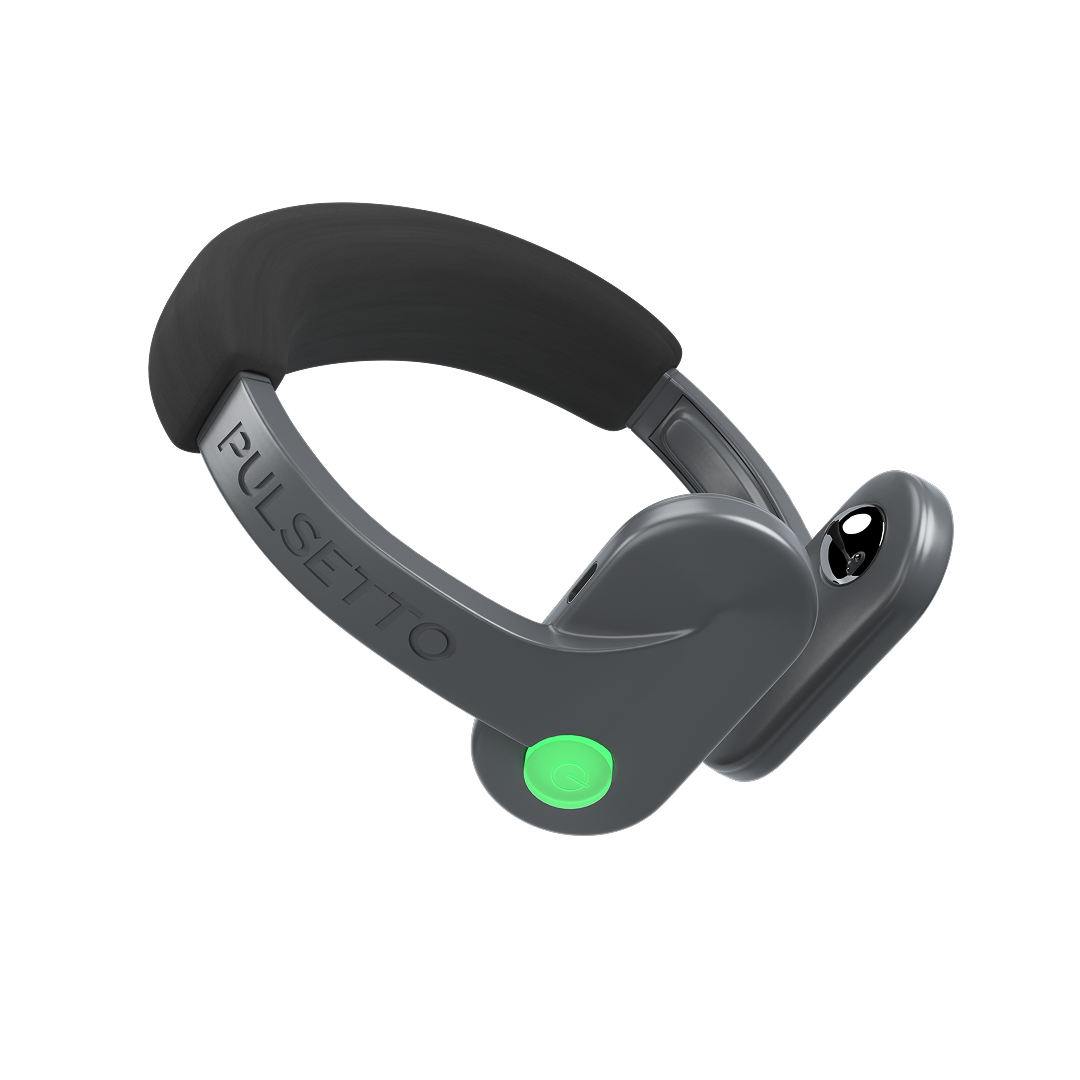
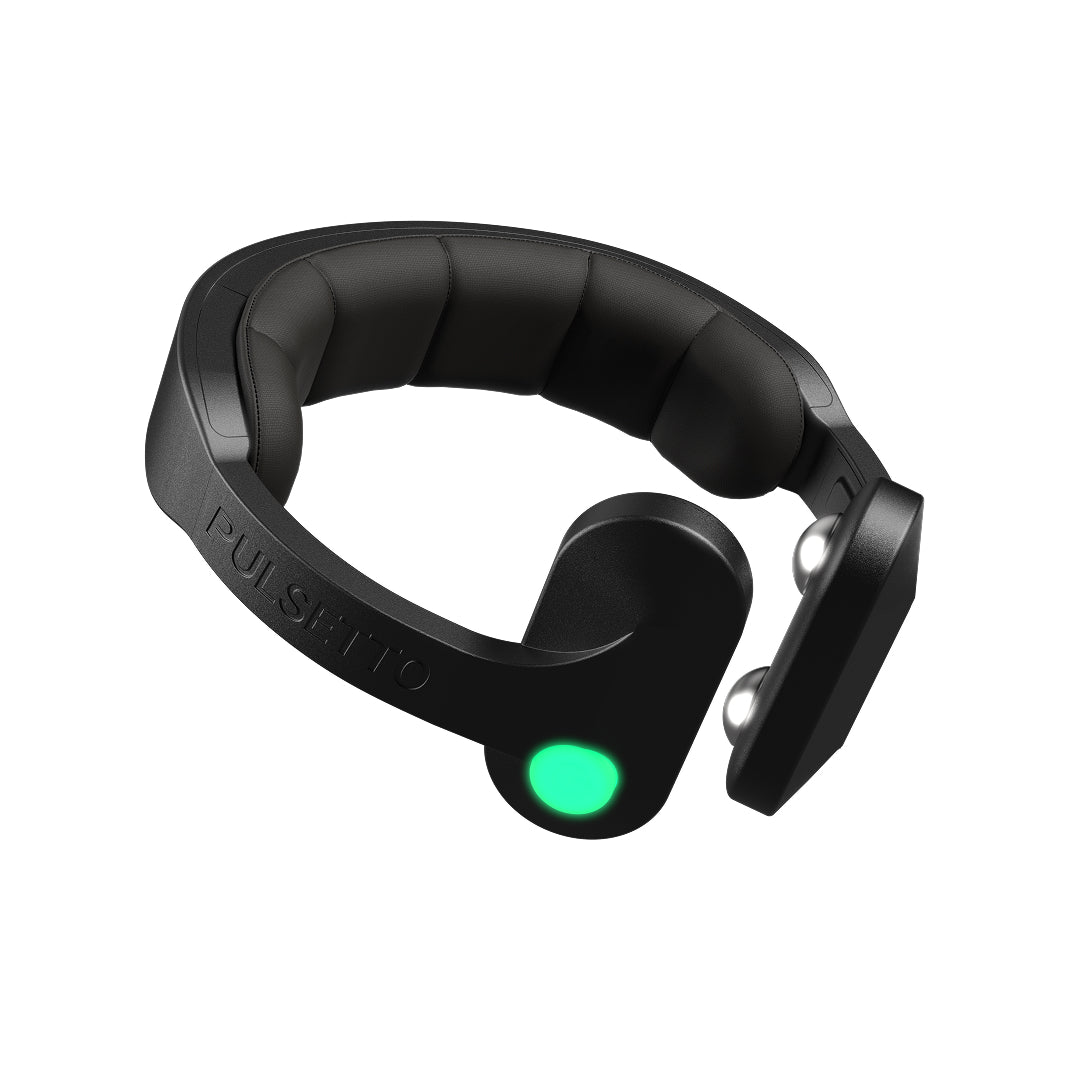
A growing category of wearables engages this pathway directly: vagus nerve stimulation (VNS) devices applied to the neck or ear. Pulsetto is one of them, a hands-free, bilateral cervical vagus nerve stimulator built for 4-minute sessions. "Bilateral" means both sides of the neck at once, which is the mechanical detail that separates it from handheld devices you hold against one side. Pulsetto is a general wellness device, not FDA-cleared, and it's not a substitute for professional medical care.
Two lines of research back the underlying mechanism here. Repeated stimulation of the vagal afferent pathway strengthens baroreceptor and vagal regulation over time. [6] Another study shows that HRV biofeedback and newer auditory-based neuromodulation methods engage that same afferent pathway. [7]
Disclaimer: Pulsetto is a general wellness product and is not intended to diagnose, treat, cure, or prevent any disease or medical condition.
The Three-Layer Stress Conditioning Model
The Three-Layer Stress Conditioning Model organizes the six methods above into a simple system: Layer 1 is physiological regulation (breathing, HRV biofeedback, vagus nerve stimulation), Layer 2 is controlled exposure (cold, exercise, structured hormetic stress), and Layer 3 is cognitive reframing (reappraisal, social co-regulation).
|
Layer
|
Methods
|
Why it goes here
|
|
Layer 1: Physiological regulation
|
Paced breathing, HRV biofeedback, vagus nerve stimulation
|
Requires the least willpower, gives the fastest measurable feedback (HRV shifts within a single session)
|
|
Layer 2: Controlled exposure
|
Cold exposure, structured exercise
|
Builds tolerance through repeated, recoverable doses of real physical stress
|
|
Layer 3: Cognitive reframing
|
Reappraisal, social co-regulation
|
Changes how you interpret and share the stress response once your body is already better regulated
|
A reasonable sequence for most people: start with Layer 1 for two weeks, since it's the fastest to notice. Add one Layer 2 method once Layer 1 feels routine. Weave Layer 3 in throughout, since it doesn't require dedicated session time the way the other two layers do.
How Long Does It Take? What to Expect Week by Week
Most people see an early, subjective shift, feeling calmer, falling asleep faster, within 1 to 2 weeks of consistent daily practice. Measurable changes in resting HRV typically take 3 to 8 weeks of consistent practice. There is no single universal timeline. Consistency matters more than intensity: five short sessions a week beats one long session.
A realistic arc looks like this:
-
Weeks 1 and 2: subjective changes first, better sleep, a calmer mood, before anything shows up in objective measurements.
-
Weeks 3 and 4: consistent practitioners often start to see small, real movement in resting HRV.
-
Weeks 6 through 8: a more stable baseline shift, the point where the change starts to feel less like an experiment and more like how your body works now.
If you're three days in and frustrated that nothing's changed, that's normal, not a sign of failure. The same circadian and allostatic-load principles from earlier in this guide explain why: your HPA axis adjusts to consistent daily signals over weeks, not single sessions. For reference, Pulsetto's own pilot study measured its outcomes over a 4-week window, which lines up reasonably well with the general timeline above, though individual results vary. Pulsetto's own stress resilience program follows a similar week-by-week arc, for anyone who'd rather follow a structured plan than assemble one from scratch.
Signs Your Stress Response Is Becoming More Resilient
The clearest sign is faster recovery, not fewer stressors. Watch for: falling asleep faster after a stressful day, a quicker return to a normal heart rate after a stressful event, less time spent ruminating, and a rising resting HRV trend over weeks (if you track it). Absence of stress isn't the goal or a realistic one; faster recovery is.
Another thing to watch for is a rising irritability threshold, the same minor annoyance that used to derail your afternoon starts to just... pass. That one tends to show up last, after sleep and heart-rate recovery have already started shifting, since noticing it takes enough distance to catch yourself not reacting.
None of these mean stress disappears. It won't. The goal here was never a stress-free life. It's a nervous system that comes back down faster when something happens.
When to Get Professional Support
Self-directed stress-response training is not a substitute for professional care. Loop in a licensed therapist or physician if stress symptoms are persistent, worsening, interfering with daily functioning, or accompanied by thoughts of self-harm. These techniques support general wellness; they are not designed to diagnose, treat, cure, or prevent any medical condition.
Watch for a few specific signals: symptoms that don't ease up after weeks of consistent practice, symptoms that are actively getting worse, stress that's interfering with work, relationships, or basic daily functioning, or any thoughts of self-harm. Any of those warrants a conversation with a licensed therapist or physician, not another breathing app.
Start Your First 4-Minute Session
Except for Pulsetto, everything in this guide works without hardware. If you want a hands-free way to add a vagus nerve stimulator to Layer 1 of the framework above, Pulsetto Lite and Pulsetto FIT are both available, each with the Free Lifetime App included.
Both devices run 4-minute sessions across Stress, Sleep, Calm, Release, and Focus modes, and are CE and FCC certified with a 2-year warranty.
Try Pulsetto to train your stress response.
Frequently Asked Questions
Can you actually train your stress response, or is it fixed?
Yes, within limits. Your baseline stress reactivity is shaped by genetics and personal history, but the HPA axis and vagal tone stay adaptable throughout life.
How do I fix my stress response?
Start with one Layer 1 method, paced breathing or HRV biofeedback, practiced daily for two weeks before adding anything else. Layer 2 (controlled exposure like cold or exercise) and Layer 3 (cognitive reappraisal) build on that foundation. There's no single fix. Consistency across weeks matters more than any one technique.
What is the 3-3-3 rule for stress?
It's a quick grounding technique for an acute stress spike, not a training method: name three things you can see, three sounds you can hear, and move three parts of your body. It can interrupt an acute stress response in the moment, but it doesn't build lasting resilience the way the methods in this guide do.
How do I get my body out of a stress response?
Slow, extended exhales, longer than your inhale, directly engage the vagus nerve and activate your parasympathetic "off switch." Paced breathing at roughly six breaths per minute, cool water on the face or hands, and brief physical movement all help shift your body out of an active stress response within minutes.
How long does it take to train your stress response?
Most people notice subjective changes, like falling asleep faster, within 1 to 2 weeks of daily practice. Measurable shifts in resting heart rate variability typically take 3 to 8 weeks of consistent practice. Pulsetto's own pilot study measured outcomes over a 4-week window, as one reference point.
Is vagus nerve stimulation, like Pulsetto, backed by science, and is it FDA approved?
The vagus nerve's role in stress regulation is supported by peer-reviewed research, and Pulsetto has its own randomized, open-label pilot study (n = 40). Pulsetto itself is not FDA-cleared. It's marketed in the US as a general wellness device, CE and FCC certified. For FDA-cleared medical use, specifically migraine and cluster headache, electroCore's gammaCore is the prescription-grade option. That's a different regulatory category from a general wellness device, and it's worth understanding the distinction rather than assuming one implies the other. People weighing that distinction tend to look at both the pilot-study data above and the real user experiences on Pulsetto's reviews page.
Who should avoid vagus nerve stimulation or similar stress-training techniques?
People with a pacemaker or other implantable medical device, epilepsy, or who are pregnant should not use vagus nerve stimulation devices, and should check with a physician before starting any new stress-training technique. These methods are general wellness tools, not medical treatments.
Scientific research
[1] The effect of heart rate variability biofeedback training on stress and anxiety: a meta-analysis (Goessl et al., 2017, Psychological Medicine, 496 citations)
[2] Digital training for building resilience: Systematic review, meta-analysis, and meta-regression (Ang et al., 2022, Stress and Health, 68 citations)
[3] Interventions to foster resilience in nursing staff: A systematic review and meta-analyses of pre-pandemic evidence(Kunzler et al., 2022, International Journal of Nursing Studies, 59 citations)
[4] Stress inoculation in mice induces global resilience (Ayash et al., 2020, Translational Psychiatry, 29 citations)
[5] Adaptation to stressors: Hormesis as a framework for human performance (Hill et al., 2024, New Ideas in Psychology, 16 citations)
[6] Heart rate variability biofeedback: how and why does it work? (Lehrer et al., 2014, Frontiers in Psychology, 816 citations)
[7] Harnessing non-invasive vagal neuromodulation: HRV biofeedback and SSP for cardiovascular and autonomic regulation (Gitler et al., 2025, Medicine International, 15 citations)
[8] The physiological significance of the circadian dynamics of the HPA axis: Interplay between circadian rhythms, allostasis and stress resilience (Rao et al., 2019, Hormones and behavior, 64 citations)