What a neck stretch can and cannot do
In the neck, the vagus nerve travels inside the same connective sheath as the carotid artery and the jugular vein, beneath the muscles a stretch lengthens. Stretching changes the length and tension of those muscles.
Four studies show what stretching does and does not do:
-
Neck and shoulder pain (the best-supported benefit). In a randomized trial of 96 office workers with moderate-to-severe neck pain, everyone received ergonomic advice, and one group added neck and shoulder stretches twice a day, five days a week, for four weeks. That group improved more on pain and neck function, and within the study, people who stretched at least three times a week gained more neck function than those who did less [1].
-
Heart rate variability (a weak link to the vagus nerve). A trial of 127 adults with persistent or recurrent neck pain gave everyone home stretching exercises for two weeks and measured heart rate variability (HRV) three times. HRV did not differ between the people whose pain improved and those whose pain did not, so feeling looser in the neck did not show up as a measurable HRV shift [2]. The authors note that more frequent measurements over a longer period would give a fuller picture.
-
Autonomic changes around a stretch (limb muscles). In a laboratory study of 24 healthy young adults, five one-minute sets of passive forearm stretching raised blood pressure during the stretch. Cardiac vagal activity rose during the recovery period that followed [3].
-
Shoulders and upper back (a possible calming reflex). In a separate group of 24 healthy people, stretching the shoulders and upper back lowered blood pressure by about as much as standing up fast does, with a smaller jump in heart rate. The authors proposed a reflex that starts in the stretched muscle, and suggested it may contribute to the sense of well-being people report after stretching those muscles [4].
Check these before you start
Sit down for all four stretches, and keep every movement slow. Talk to a doctor before starting if you have had a neck injury or neck surgery, if you have been told there is a problem with the arteries in your neck, or if neck movement has ever brought on dizziness, numbness or tingling in your arms. Sharp pain, or pain that travels down an arm, is a reason to stop and not something to stretch through. If any movement has ever made you black out or nearly faint, skip this routine and mention it to a clinician.
The four-stretch routine
The whole sequence takes about five minutes. Move into each position until you feel a mild, comfortable pull, and let your breathing stay natural.
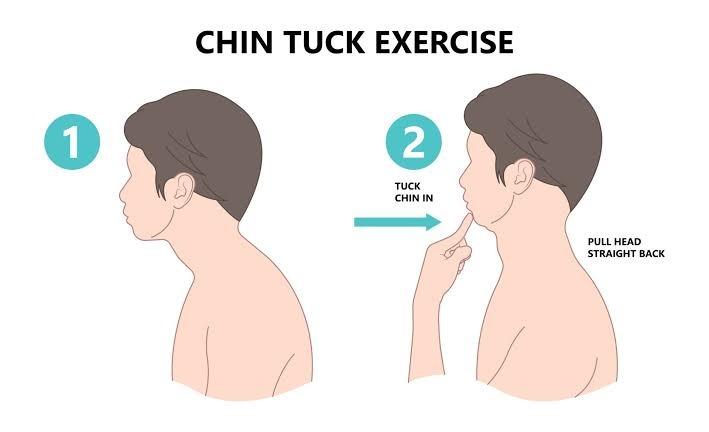
Chin tuck
Source
Sit tall and look straight ahead. Glide your chin straight back, as if you were making a double chin, without tipping your head down. Hold for 5 seconds, then release and repeat eight times. The movement draws your head back over your shoulders, so it suits the moment you notice your head has crept forward over a screen.
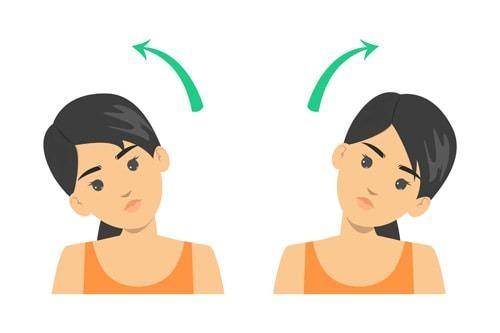
Side tilt
Source
Hold the edge of your seat with one hand to anchor that shoulder. Tilt your opposite ear toward your shoulder and let the weight of your head provide the stretch along the side of the neck. Hold for 20 to 30 seconds, then switch sides and do two rounds in total.
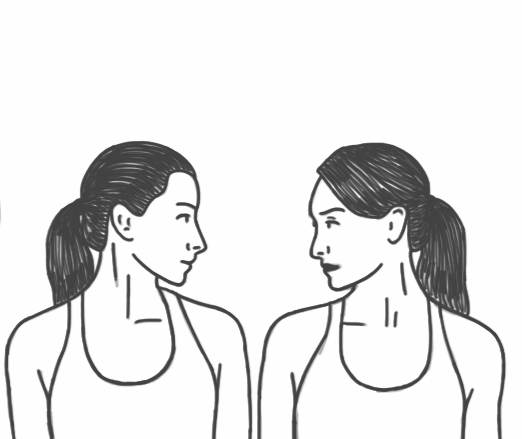
Look over the shoulder
Source
With your chin level, turn your head to look over one shoulder, stopping at the first mild stretch. Keep your gaze level, since tipping the head back changes the stretch and takes it somewhere you are better off avoiding (more on that below). Hold for 15 to 20 seconds on each side, twice.
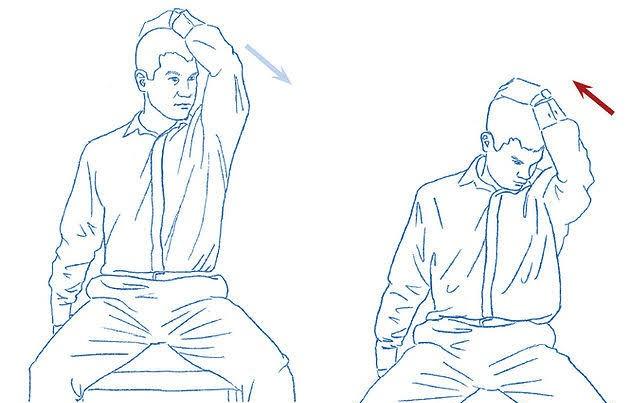
Angled neck stretch
Source
Turn your nose halfway toward one armpit, then let your chin drop gently, which lengthens the muscles at the back and side of the neck. Hold for 20 to 30 seconds on each side. If you feel pinching at the base of the neck, ease back to where it feels comfortable.
|
Stretch
|
Hold
|
Repeats
|
Where you should feel it
|
|
Chin tuck
|
5 seconds
|
8
|
Back of the neck, base of the skull
|
|
Side tilt
|
20 to 30 seconds
|
2 per side
|
Side of the neck, top of the shoulder
|
|
Look over the shoulder
|
15 to 20 seconds
|
2 per side
|
Side of the neck
|
|
Angled neck stretch
|
20 to 30 seconds
|
1 to 2 per side
|
Back and side of the neck
|
The hold times are a comfortable starting point and not figures taken from a trial. The one dose with trial support is the schedule from the office-worker study: twice a day, five days a week.
What to leave out
Skip stretches that throw the head back or arch the upper back hard, and skip neck cracking and forced rolls. Stretch-induced syncope, a brief loss of consciousness, is rare. A 2026 review of 12 studies describing 30 patients aged 5 to 26 found that the episodes were triggered by neck hyperextension and upper-back stretching, and that the mainstays of management were education and avoiding the movements that provoke them [5].
A 2025 laboratory study compared nine patients with the condition against 24 controls. Shoulder and upper-back extension lowered blood pressure in both groups, and the drop was larger in the patients [6]. Both the calm that many people feel after these movements and the faint that a few people experience involve a fall in blood pressure; the fall is simply larger in people prone to fainting. If you feel lightheaded during any stretch, come out of it slowly and stay seated until the feeling passes.
Fitting it into your day
Twice a day matches the schedule from the trial: once soon after you sit down to work, and once in the evening. Treat the routine as one input among several. Movement, sleep and company are the everyday habits that shift cortisol over weeks, and a stretch session fits into that list without replacing any of it.
The evening round slots in beside the bedroom changes that make sleep easier, such as blackout curtains and cooler bedding, which act on the room and leave your own routine untouched.
Give it a few weeks before you judge it. A single reading will not tell you much, and a better test is how fast you recover after a hard day: how long the tension lingers, how quickly you settle once the work ends, and how you sleep that night.
Where Pulsetto fits next to stretching

Stretches look after the muscles around the neck. Pulsetto is designed to send signals to the nerve itself, so the two do different jobs and can share a routine.
Pulsetto is a wireless, hands-free vagus nerve stimulator that sits on the neck, where the vagus nerve runs closest to the skin. With electrode gel on the contact points, it delivers gentle electrical stimulation to both sides of the neck, and you start each session from the app. The two-sided design is the feature Pulsetto points to as setting it apart from one-sided devices.
The aim is to give the nerve a steady, calm input. The brainstem uses vagal signals, among others, to help set heart rate and the balance between alertness and rest, and Pulsetto is designed to nudge that balance toward the parasympathetic "rest and digest" side. The stress program runs for 4 minutes and can be used at any time of day. The sleep program runs for 10 minutes, about 30 minutes before bed, which pairs naturally with the evening stretch round.
In Pulsetto's own randomized, open-label pilot study (n=40, 4 weeks), participants reported a 41.0% reduction in PSQI sleep-disturbance scores. Pulsetto is a general wellness product designed to support calm and recovery from everyday stress. Anyone with a pacemaker, an implantable device or epilepsy should not use it, and anyone with recent neck or throat surgery or carotid artery problems should speak to a physician first.
Start with one pass today
Sit down, run through the four stretches once, and notice how your neck feels afterward. Do it again tomorrow. If a calmer evening is the next thing on your list, see what Pulsetto offers for stress and sleep.
Best Vagus Nerve Stretch Exercises FAQs
Is stretching enough for neck pain, or should I add strengthening?
Strengthening has the stronger trial record. In a 12-month trial of 180 female office workers with chronic neck pain, both strength training and endurance training reduced pain and disability, and the authors found that stretching and aerobic exercise alone were a much less effective form of training than strength training [7]. A review of exercise for office workers with neck pain reached a similar picture: strengthening favored over no exercise for pain reduction, with the effect of stretching needing further study because only one stretching study was included [8]. The routine above suits stiffness and a short break, and if neck pain keeps coming back, a physiotherapist can add a strengthening program.
Does forward head posture cause neck pain?
The two are linked in the data, though the direction is not settled. A meta-analysis of 15 cross-sectional studies found that adults with neck pain showed more forward head posture than adults without it, and that posture measures correlated with neck pain intensity and disability in adults and older adults. Age confounded the relationship, and in adolescents most pain measures showed no association [9]. Cross-sectional studies compare people at a single point in time, so they cannot show which came first.
Can neck and shoulder exercises help with headaches?
Possibly, in office workers. In a secondary analysis of a stepped-wedge trial of 120 office workers, a 12-week supervised program of neck and shoulder girdle exercises plus health promotion at the workplace was linked to lower odds of headache (odds ratio 0.46, 95% CI 0.25 to 0.84) and a 2.23-point lower score on the HIT-6 headache impact scale, a change that did not reach clinical importance [10]. Headache was a secondary outcome, and the trial tested supervised exercise, so a short seated stretch routine was never part of it. A headache that is new, severe or comes with weakness or vision changes is one for a clinician.
Who should not use Pulsetto?
Do not use Pulsetto if you have a pacemaker, an implantable medical device, or epilepsy, and do not use it while pregnant unless a healthcare provider has cleared you. Talk to a doctor first if you have a cardiovascular condition, recent neck or throat surgery or injury, or carotid artery problems.
Scientific research
-
The effectiveness of a neck and shoulder stretching exercise program among office workers with neck pain: a randomized controlled trial (Tunwattanapong et al., 2016, Clinical Rehabilitation)
-
Are changes in pain associated with changes in heart rate variability in patients treated for recurrent or persistent neck pain? (Bakken et al., 2022, BMC Musculoskeletal Disorders)
-
Cardiovascular and autonomic responses in young adults during and after mechanoreflex activation via passive forearm stretching: are there sex differences? (Lehnen et al., 2025, Journal of Applied Physiology)
-
Stretch-induced blood pressure moderation: A potential basis for the sense of well-being accompanying stretching of upper back and neck muscles (Reyes et al., 2025, Physiological Reports)
-
Stretch-induced syncope: An examination of a rarely recognized condition (Keller et al., 2026, Trends in Cardiovascular Medicine)
-
Stretch syncope in humans: Evidence for symptomatic neural reflex hypotension triggered by stretching of shoulder and upper back muscles (Kosmopoulos et al., 2025, Heart Rhythm)
-
Active neck muscle training in the treatment of chronic neck pain in women: a randomized controlled trial (Ylinen et al., 2003, JAMA)
-
Effectiveness of exercise in office workers with neck pain: a systematic review and meta-analysis (Louw et al., 2017, South African Journal of Physiotherapy)
-
The relationship between forward head posture and neck pain: a systematic review and meta-analysis (Mahmoud et al., 2019, Current Reviews in Musculoskeletal Medicine)
-
Effects of neck-exercise and health promotion on headache outcomes in office workers: secondary analysis of the NEXpro stepped wedge cluster randomised controlled trial (Ernst et al., 2025, The Journal of Headache and Pain)