What the body does as sleep starts
Three laboratory studies describe the handover:
-
Sleep onset in 34 people. In whole-night recordings, very-low-frequency heart rhythm power began to fall about two minutes before sleep onset, and the balance of sympathetic to parasympathetic activity moved toward the parasympathetic side. People with sleep apnea or other sleep disorders showed more sympathetic predominance both before and after sleep onset [1].
-
Lights off, under controlled conditions. Fifteen healthy young adults lived on a 72-hour schedule of 60-minute waking periods in dim light alternating with 60-minute nap opportunities in darkness. Turning the lights off was associated with a rapid rise in parasympathetic modulation of the heart, while low-frequency power and the sympathovagal ratio fell [2].
-
Deeper sleep, further shift. In the same 72-hour design, sleep onset and progression to deeper stages were associated with greater parasympathetic modulation, and REM sleep with a shift toward sympathetic modulation [3].
None of the three tested an evening routine. They explain why the last hour before bed matters, and the clock below puts that to use.
Jonė Pukėnaitė, MD, Medical & Science Lead at Pulsetto: "Sleep onset is a handover you can set up and cannot force. An evening routine earns its place by removing whatever keeps the handover from starting, so judge it by how settled you feel at lights out and give it a few weeks before you decide."
The 60-minute clock
Each slot has one job. The times are a template, so shift the whole clock to match your own lights-out time.
|
Before lights out
|
Step
|
Length
|
Why it sits here
|
|
60 minutes
|
Finish any vigorous workout
|
Done by this point
|
Evening exercise did not harm sleep overall in a meta-analysis, but vigorous exercise ending within an hour of bed might delay sleep onset and shorten sleep [4]
|
|
55 minutes
|
Write tomorrow's three tasks on paper
|
5 minutes
|
Common practice and not tested in these studies; it gets tomorrow out of your head
|
|
45 minutes
|
Quiet, low-effort activity such as reading or tidying
|
15 minutes
|
A stretch with no demands before the body is asked to wind down; a practical slot and not a studied one
|
|
30 minutes
|
Optional: Pulsetto Sleep program
|
10 minutes
|
The program's suggested start time; details in the Pulsetto section below
|
|
20 minutes
|
Slow, easy breathing, seated or lying down
|
15 minutes
|
A 30-day trial used 15 evening minutes and reported better subjective sleep quality [5]
|
|
0 minutes
|
Lights out, nothing left to do
|
|
Lights off was followed by a rapid rise in parasympathetic modulation in the laboratory [2]
|
The 45-minute slot is the loosest, so swap it for whatever quiet activity you will actually do. A shorter clock you keep up is worth more than a full one you skip. The breathing step is deliberately unspecific about pace: stay relaxed, let the exhale run a little longer than the inhale, and stop if you feel lightheaded.
What the bedtime trials measured
The trials behind the clock are small and mostly short, and their results differ by how sleep was measured:
-
Review of slow breathing before bed. Nine studies with 457 participants met the inclusion criteria. Self-reported sleep duration and sleep quality improved after slow breathing before bedtime, while the findings from objectively measured sleep (actigraphy in two studies, polysomnography in three) were inconclusive. The three objective studies used one-day protocols and the five self-report studies used 28 to 30 days. The authors called for more high-quality studies with longer interventions [6].
-
A 30-day trial against social media. Sixty-four healthy participants (mean age 22) were randomly assigned to 15 minutes of slow-paced breathing each evening through a smartphone app or to 15 minutes of social media. Slow-paced breathing improved subjective sleep quality on the Pittsburgh Sleep Quality Index and increased overnight cardiac vagal activity compared with social media [5].
-
A one-night sleep-lab pilot. Twenty young adults did a 30-minute slow breathing exercise or listened to 30 minutes of music before bed, each compared with a control night, with sleep recorded by polysomnography. Both conditions raised HRV immediately. Some indices pointed to better sleep, but neither condition had robust effects on sleep quality, and the authors called the findings exploratory [7].
Put together, the studies show that people report sleeping better after weeks of bedtime breathing, and recorded sleep has not yet backed that up. Treat the clock as an experiment: run it for a few weeks and judge it by how you feel.
Who should adapt it
Slow breathing is gentle, and anyone who feels dizzy or tingly should stop and breathe normally. Trouble falling asleep that goes on for weeks, or loud snoring with pauses in breathing that a partner notices, deserves a conversation with a doctor, because those need assessment and a routine will not fix them. The 34-person recordings above found more sympathetic activity around sleep onset in people with sleep apnea or other sleep disorders [1].
Where Pulsetto fits on the clock
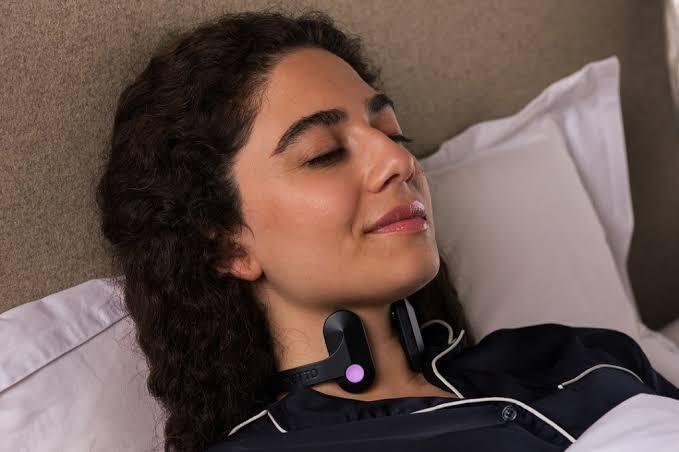
Pulsetto occupies one slot, the 30-minute step. It is a wireless, hands-free vagus nerve stimulator worn on the neck, with electrode gel on the contacts, and the free app runs it. The Sleep program lasts 10 minutes and the app suggests starting about 30 minutes before bed, which is why it sits at that point on the clock and finishes before the breathing step. In Pulsetto's own randomized, open-label pilot study (n=40, 4 weeks), participants reported a 41.0% reduction in PSQI sleep-disturbance scores.
If you also use the 4-minute stress program during the evening, run it before the clock starts. Pulsetto's stress relief protocol leaves at least 45 minutes between sessions, so a stress session at the 60-minute mark leaves the Sleep program room at the 30-minute mark. Pulsetto is a general wellness device and not a medical device. Anyone with a pacemaker, an implantable device or epilepsy should not use it, and the full list is in the FAQ below.
Fix one time tonight
Pick your lights-out time, count back 30 minutes and set one alarm for that point. That single anchor is enough for the first evening: do whatever calms you at that mark, and add the other slots one at a time once it feels routine. If you want a hands-free step at that mark, Pulsetto has a 10-minute Sleep program for it.
Best Vagus Nerve Exercises for Sleep FAQs
Does a warm bath or shower before bed help me fall asleep?
It may, if you time it well ahead of bed. In a longitudinal study of 1,094 older adults (mean age 72), nights with a hot bath 61 to 180 minutes before bedtime had a shorter time to fall asleep, on both actigraphy and self-report, than nights with no bath, and a higher skin temperature gradient in the 30 minutes before bed [8]. In a study of 23 healthy adults who bathed 1.5 to 2 hours before bed, a long tub bath shortened actigraphic sleep onset compared with showering only, and people rated falling asleep and sleep quality better after it [9]. These are observational or small studies, so treat a bath as something to try, and place it before the first slot of the clock. Take care with hot water if you have a heart condition or low blood pressure, and ask your doctor if you are unsure.
How late can I have coffee without hurting my sleep?
Earlier than most people expect. A meta-analysis of 24 studies found that caffeine reduced total sleep time by 45 minutes and sleep efficiency by 7%, and added about 9 minutes to the time taken to fall asleep and 12 minutes of waking after sleep onset. Its authors estimated that a standard coffee (107 mg per 250 mL) should be consumed at least 8.8 hours before bedtime to avoid losing total sleep time [10]. An earlier systematic review found clear dose and timing effects, large differences between individuals and possibly greater sensitivity in older adults [11]. To test your own response, move your last coffee a few hours earlier for a week and compare.
Does looking at a screen before bed affect sleep?
In a controlled laboratory study that compared reading on a light-emitting eReader with reading a printed book in the hours before bed, participants using the eReader took longer to fall asleep and had less evening sleepiness, reduced melatonin secretion, a later circadian clock and lower alertness the next morning [12]. The study used one device type in a lab, so how much your own phone matters is still open. A printed book is the lower-risk choice for the 45-minute slot of the clock.
Who should not use Pulsetto?
Do not use Pulsetto if you have a pacemaker, an implantable medical device, or epilepsy, and do not use it while pregnant unless a healthcare provider has cleared you. Talk to a doctor first if you have a cardiovascular condition, recent neck or throat surgery or injury, or carotid artery problems.
Scientific research
-
Autonomic changes during wake-sleep transition: a heart rate variability based approach (Shinar et al., 2006, Autonomic Neuroscience)
-
A circadian rhythm in heart rate variability contributes to the increased cardiac sympathovagal response to awakening in the morning (Boudreau et al., 2012, Chronobiology International)
-
Circadian variation of heart rate variability across sleep stages (Boudreau et al., 2013, Sleep)
-
Effects of Evening Exercise on Sleep in Healthy Participants: A Systematic Review and Meta-Analysis (Stutz et al., 2019, Sports Medicine)
-
Influence of a 30-Day Slow-Paced Breathing Intervention Compared to Social Media Use on Subjective Sleep Quality and Cardiac Vagal Activity (Laborde et al., 2019, Journal of Clinical Medicine)
-
Slow breathing techniques before bedtime and the effects on sleep: A systematic review (Eide et al., 2026, Sleep Medicine Reviews)
-
The Effects of Presleep Slow Breathing and Music Listening on Polysomnographic Sleep Measures - a pilot trial (Kuula et al., 2020, Scientific Reports)
-
Hot-water bathing before bedtime and shorter sleep onset latency are accompanied by a higher distal-proximal skin temperature gradient in older adults (Tai et al., 2021, Journal of Clinical Sleep Medicine)
-
Effects of bathing-induced changes in body temperature on sleep (Maeda et al., 2023, Journal of Physiological Anthropology)
-
The effect of caffeine on subsequent sleep: A systematic review and meta-analysis (Gardiner et al., 2023, Sleep Medicine Reviews)
-
Coffee, caffeine, and sleep: A systematic review of epidemiological studies and randomized controlled trials (Clark et al., 2017, Sleep Medicine Reviews)
-
Evening use of light-emitting eReaders negatively affects sleep, circadian timing, and next-morning alertness (Chang et al., 2015, Proceedings of the National Academy of Sciences)