The gap in every "best stress tracker" list
Type "best stress tracker" into Google and you'll get roughly the same six names back: Oura, WHOOP, Garmin, Apple Watch, Fitbit, Samsung. Every review measures the same thing: how accurately each device estimates stress from heart rate variability, skin temperature, or electrodermal activity. Reviewers then judge how clearly each one displays that estimate.
That's a real, useful capability. A 2023 scoping review of 40 studies on wearables for stress management found that most commercial devices are genuinely good at detecting elevated stress states [2]. What the review also found is more interesting: the interventions that actually reduced stress shared one trait, active self-regulation, like guided breathing paced to a target heart rate, instead of passive awareness alone.
A 2025 study on Dutch police officers makes the same point with real numbers. Officers who wore a Garmin Forerunner 255 with a stress-tracking app for five weeks saw improvement on 8 of 15 measured stress and well-being outcomes, but the effect sizes were small, in the Hedges' g = 0.25 to 0.46 range [1]. The device made people more aware of their stress. Awareness alone moved the needle, but not by much.
Heart rate variability biofeedback training goes a step further: the device actively coaches a specific physiological skill, usually slow, paced breathing, session by session. A meta-analysis of 24 studies found a pre-post effect size of Hedges' g = 0.81 for reducing self-reported stress and anxiety [4], roughly double what passive monitoring achieved. A separate systematic review across 58 studies found HRV biofeedback training produced its largest effects specifically on anxiety and performance outcomes [5].
None of this means a tracker is a waste of money. It means "best stress wearable" is actually two different questions, and most lists only answer one of them.
Ready to see the option built for training instead of tracking before you compare the rest? Check out Pulsetto's vagus nerve stimulator.
Quick comparison
|
Wearable
|
What it does
|
Price
|
Best for
|
|
Pulsetto
|
Trains the vagus nerve directly with bilateral cervical stimulation
|
$269 (Lite) / $296 (FIT)
|
Actively lowering your baseline stress response
|
|
Oura Ring Gen 5
|
Measures HRV, sleep, plus three stress metrics (Daytime, Resilience, Cumulative)
|
$399-$499 + $5.99/mo
|
Long-term trend data in an unobtrusive ring
|
|
WHOOP 5.0 / MG
|
Real-time stress monitor, recovery and strain scoring
|
$199 to $359/yr (device included)
|
Athletes already tracking training load
|
|
Garmin Forerunner 165
|
Body Battery energy score alongside HRV and stress
|
$249.99
|
Runners who want stress data without a monthly fee
|
|
Apple Watch Series 12
|
HRV sampled every 5 minutes, daily Readiness score
|
$399
|
iPhone users who want stress folded into a watch they already wear
|
|
Fitbit Charge 6
|
Stress Management Score built from HRV, exertion, plus sleep
|
$159.95
|
Budget-friendly, simple daily stress score
|
Pricing verified at time of writing and subject to change; check each brand's site for current figures.
How wearables actually measure stress
Every device on this list leans on the same underlying signal: heart rate variability, the tiny fluctuations in time between heartbeats. Lower HRV generally tracks with higher sympathetic (fight-or-flight) activity. Higher HRV tracks with better parasympathetic recovery.
-
Oura turns this into three separate readouts: Daytime Stress (right now), Resilience (how well you bounce back over weeks), plus Cumulative Stress (the long-term load). It's the most granular breakdown of the group.
-
WHOOP collapses it into a live Stress Monitor plus its long-standing Recovery score, both built from HRV and resting heart rate.
-
Garmin feeds HRV and activity data into Body Battery, a 0 to 100 energy reserve that drains with stress and activity and refills with rest.
-
Apple Watch added a dedicated Vitals app that samples HRV roughly every five minutes rather than once overnight, then rolls it into a daily 0 to 10 Readiness score.
-
Fitbit blends HRV, exertion, plus sleep into a single daily Stress Management Score, with EDA sensing on select models for manual stress scans.
A biomarker research review looking specifically at HRV as a marker of resilience concluded that vagally mediated HRV can serve as a plausible, noninvasive indicator of how flexibly someone adapts to stressors [3]. That's a genuinely useful diagnostic signal. The same review flagged that most of the underlying evidence comes from short lab-based stress tasks instead of real-world resilience built over time. A number on a screen works as a snapshot. A snapshot doesn't train anything.
Where active training outperforms passive tracking
Every "best stress tracker" roundup skips the part that happens once you already know your score is high.
Heart rate variability biofeedback (HRV-BFB) is the closest wearable-adjacent category to actual training, and it has a real evidence base behind it. A workplace study had employees run a four-week mobile HRV biofeedback program during work hours. Burnout scores dropped with effect sizes of d = 0.63 to 0.69, more than double the improvement seen in a waitlist control group, and sleep quality improved too [6]. This wasn't a passive dashboard. Participants actively practiced slowed, paced breathing while watching real-time feedback on their heart rhythm.
Pulsetto takes a different route to the same underlying nerve. Instead of biofeedback-guided breathing, it delivers bilateral cervical stimulation directly to the vagus nerve for roughly four minutes per session. A systematic review of transcutaneous vagus nerve stimulation in healthy adults found measurable increases in HRV parameters across the majority of included trials, even though study protocols varied widely [7]. It's a mechanistically different tool than a tracker or a breathing app, aimed at the same nervous system pathway.
The wearables, one by one
Oura Ring Gen 5
![]()

Oura's three-tier stress breakdown (Daytime, Resilience, Cumulative) carries over from the previous ring generation and is still the most detailed on the market, and the ring form factor means people who won't wear a watch actually keep it on. The trade-off is real: $399 to start for Silver or Black, up to $499 for premium finishes, plus a mandatory $5.99/month (or $69.99/year) membership to unlock any of the stress data at all. Good fit for someone who wants granular, long-term trend data and doesn't mind paying a subscription for it.
WHOOP 5.0 / MG

WHOOP has no upfront hardware cost; the device comes with membership, priced from $199 to $359 a year depending on tier. Its real-time Stress Monitor is built for people already tracking training load and recovery, mostly athletes. The catch: several of its most useful features, including ECG and blood pressure insights on the MG model, sit behind the top $359/year tier. Good fit for someone already deep in WHOOP's ecosystem for training, less so for someone who just wants a stress number.
Garmin Forerunner 165

At $249.99 with zero subscription fee, Garmin is the most straightforward buy-once option here. Body Battery is genuinely intuitive: a battery icon that drains and fills, no interpretation required. It's built primarily as a running watch, so the stress features ride along rather than lead. Good fit for runners who want stress data bundled into a device they're buying for training anyway.
Apple Watch Series 12

The new Health Sensing System samples HRV every five minutes instead of relying on overnight snapshots, and the Readiness score folds that into a same-day recommendation. At $399 with no subscription required, it's the best option for anyone already inside the Apple ecosystem. It's also the most expensive single-purchase device on this list if stress tracking is the only reason you're buying it.
Fitbit Charge 6

Fitbit's Stress Management Score is the simplest of the group: one number, built from HRV, exertion, plus sleep. At roughly $99 to $159.95 depending on where you buy it, it's the cheapest way onto this list, though the detailed breakdown behind that score is locked behind Fitbit Premium at $9.99 a month. Good fit for someone who wants a basic daily signal without spending WHOOP or Oura money.
Pulsetto: training instead of tracking

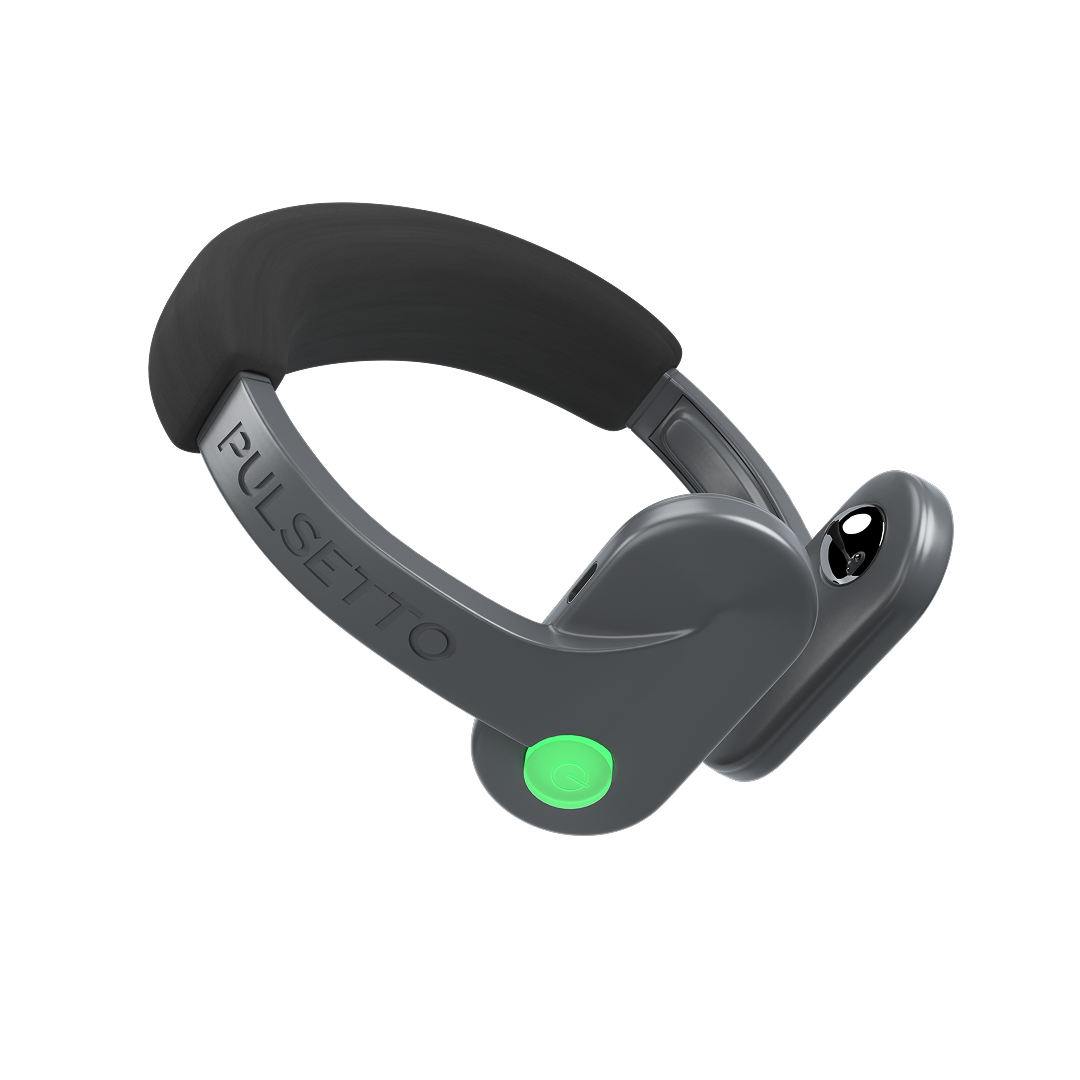
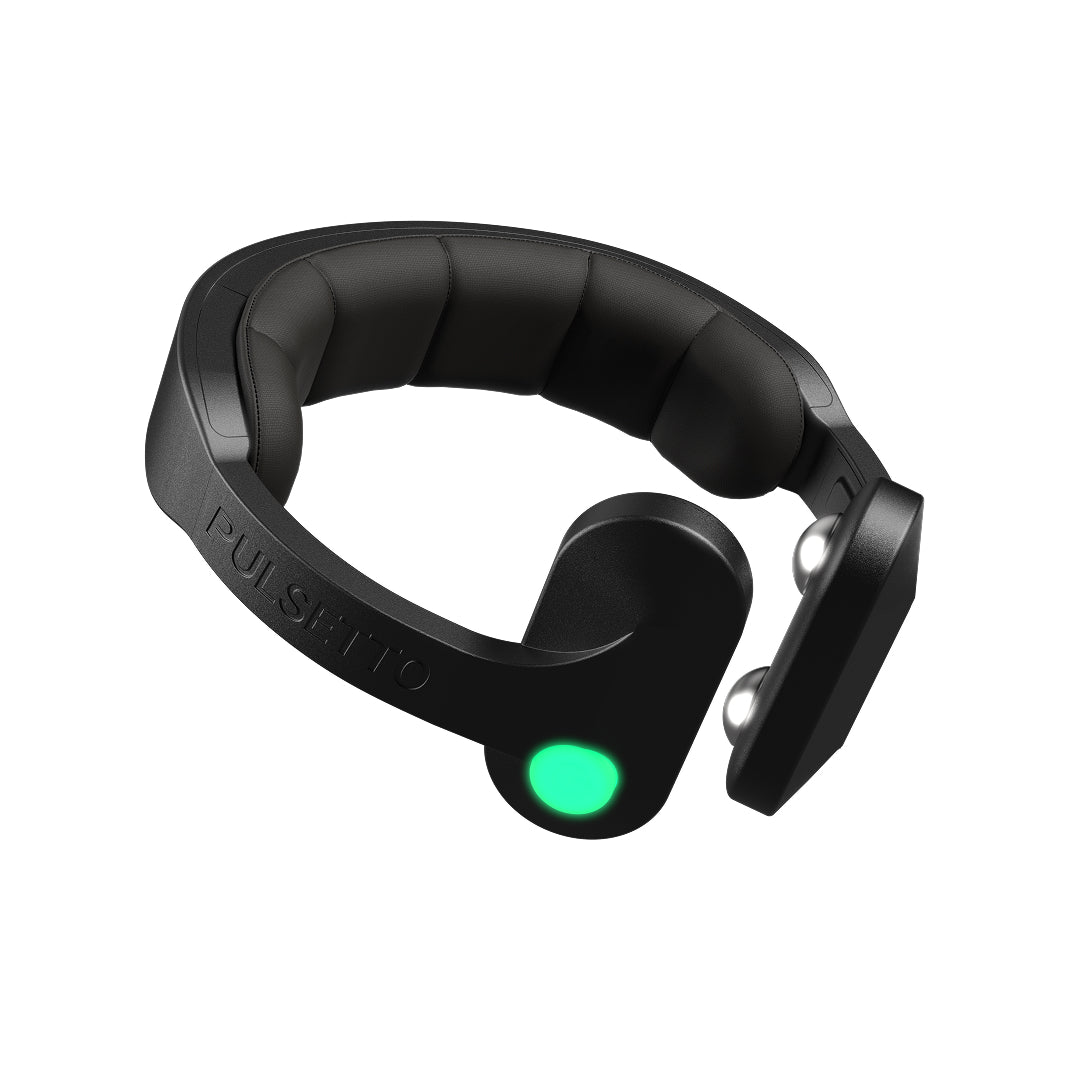
Pulsetto is a hands-free, bilateral vagus nerve stimulator worn on the neck for roughly four minutes a session. It doesn't produce a stress score, a trend graph, or a readiness percentage. It's designed to act on your nervous system directly.
The bilateral part matters. In Pulsetto's own randomized, open-label pilot study (n=40, 4 weeks), participants using bilateral stimulation saw larger reductions in hair cortisol and cortisone, the body's chronic stress biomarkers, than participants using unilateral stimulation. Measuring cortisol falls well outside what any tracker on this list is built to do.
In Pulsetto's own in-app wellbeing check-ins, separate from that pilot study, 73% of users report lower stress after starting, with the reported reduction growing from 23% at their two-week check-in to 26% by the next one. Among everything on this list, tracker or trainer, it's the closest available answer to "does this actually change how people feel day to day."
The Free Lifetime App includes five stimulation programs (Stress, Sleep, Burnout, Pain, Anxiety) with no recurring cost, which puts Pulsetto's ongoing price closer to Garmin's buy-once model than to Oura's or WHOOP's subscription requirement. At $269 for the Lite model, it also undercuts every tracker on this list except Fitbit on upfront cost, while doing a fundamentally different job.
Disclaimer: Pulsetto is a general wellness product and is not intended to diagnose, treat, cure, or prevent any disease or medical condition.
How to actually choose between them
Buying the wrong category of device here is an easy mistake, so work through these questions in order.
-
Do you want data, or do you want a session? A tracker gives you a number to interpret. Pulsetto gives you something to do for four minutes. These solve different problems and most people eventually want both.
-
Are you already inside an ecosystem? If you live in Apple Health or you're deep in WHOOP's training-load data, staying in that ecosystem for stress tracking specifically usually beats switching brands.
-
Will a subscription actually get used? Oura's $5.99/month and Fitbit's $9.99/month only pay for themselves if you check the app regularly. None of Garmin, Apple, or Pulsetto's core stress features require an ongoing fee.
-
Does the session length fit your day? Pulsetto's four minutes fits into a work break. HRV biofeedback programs like the ones in the research above typically ran 10-20 minutes daily. A tracker asks for zero minutes of your attention beyond wearing it.
-
What's the evidence behind the specific claim you care about? A stress score is validated against how well it correlates with self-reported stress in the moment. A training claim needs evidence that repeated use changes the baseline. Ask which one the product you're considering is actually built to prove.
Most people who take stress seriously end up owning something from each category: a tracker for visibility, and a tool built to act on what the tracker shows them.
Buying a tracker tells you your stress is high. It doesn't lower it. If you want a device that works on the second half of that problem, one built to train your nervous system's response rather than narrate it, Pulsetto is worth four minutes of your day to find out what changes.
FAQ
Is a wearable stress tracker accurate?
Reasonably, for what it's designed to do. Devices using heart rate variability correlate well with self-reported stress in research settings, as the resilience-marker review above found, though accuracy drops during movement and varies between wrist, ring, and chest placements. Treat the number as a useful trend indicator instead of a diagnosis.
Can a wearable actually reduce my stress, or just tell me about it?
Passive tracking alone shows small effects on stress outcomes, in the Hedges' g = 0.25 to 0.46 range the police-officer study above found. Devices built around active training, like HRV biofeedback or vagus nerve stimulation, show larger effects, per the research earlier in this article. If reduction is the goal, look at what the device asks you to actively do instead of what it simply reports.
Is Pulsetto FDA approved?
No. Pulsetto is marketed as a general wellness device, the FDA category for products that don't make specific medical claims. It is CE certified and FCC certified. Some competitors in the broader vagus nerve stimulation space, like gammaCore, are FDA-cleared specifically for migraine and cluster headache, a different use case from general stress and wellness support.
Do I need both a tracker and Pulsetto?
Not necessarily, but they're not competing for the same job. A tracker shows you when your stress is elevated. Pulsetto is something you use in response, whether or not a tracker told you to. Plenty of people use a Garmin or Apple Watch for visibility and a four-minute Pulsetto session as the action step.
Who shouldn't use a vagus nerve stimulator like Pulsetto?
Anyone with any of the following should avoid it:
Anyone with a cardiovascular condition, a recent neck or throat surgery, or a carotid artery issue should consult a doctor before use.
Scientific research
[1] The Effects of Self-Monitoring Using a Smartwatch and Smartphone App on Stress Awareness, Self-Efficacy, and Well-Being-Related Outcomes in Police Officers: Longitudinal Mixed Design Study (de Vries et al., 2025, JMIR mHealth and uHealth, 10 citations)
[2] Wearables for Stress Management: A Scoping Review (González Ramírez et al., 2023, Healthcare, 55 citations)
[3] Heart rate variability: Can it serve as a marker of mental health resilience? (Perna et al., 2020, Journal of Affective Disorders, 114 citations)
[4] The effect of heart rate variability biofeedback training on stress and anxiety: a meta-analysis (Goessl et al., 2017, Psychological Medicine, 503 citations)
[5] Heart Rate Variability Biofeedback Improves Emotional and Physical Health and Performance: A Systematic Review and Meta Analysis (Lehrer et al., 2020, Applied Psychophysiology and Biofeedback, 370 citations)
[6] Mobile Heart Rate Variability Biofeedback for Work-Related Stress in Employees and the Influence of Instruction Format (Digital or Live) on Training Outcome: A Non-Randomized Controlled Trial (Vagedes et al., 2024, Applied Psychophysiology and Biofeedback, 4 citations)
[7] A systematic review of the effects of transcutaneous auricular vagus nerve stimulation on baroreflex sensitivity and heart rate variability in healthy subjects (Soltani et al., 2023, Clinical Autonomic Research, 38 citations)