The Wind Down Period Before Bed: What It Is and How to Do It
The Wind Down Period Before Bed: What It Is and How to Do It
A wind down period before bed is the block of quiet, low-stimulation time you give yourself in the last 30 to 60 minutes of the day, before you actually try to sleep. It is the bridge between a busy, alert daytime state and the calm, settled state your body needs to fall asleep easily. During this window you dim the lights, step away from screens and work, and shift to slow, soothing activities that tell your brain and body the day is ending. Done consistently, a wind down routine helps your nervous system move out of go-mode and into rest, so sleep arrives more naturally instead of being forced.
Most people treat sleep like a light switch. They stay busy and stimulated right up until they get into bed, then expect to drop off within minutes. Sleep does not work that way. Your body needs a runway. This guide explains what a wind down period is, what "winding down" means for your physiology, how long to wind down before bed, and how to build a calming pre-sleep routine that works with your biology rather than against it.
Pulsetto is a general wellness product and is not intended to diagnose, treat, cure, or prevent any disease or medical condition.
Try Pulsetto: A four-minute Sleep session with the Pulsetto vagus nerve stimulator can sit at the center of your wind down routine, gently supporting the shift from a busy day into a calmer, more settled evening. General wellness use, hands-free, no subscription required for core features.
What is a wind down period before bed?
A wind down period is a deliberate stretch of calm time, usually 30 to 60 minutes, that separates your active day from sleep. Instead of going straight from a screen, a workout, or a stressful conversation into bed, you give yourself a transition. You lower the intensity of everything around you: the lights, the noise, the pace of your thoughts, and the demands on your attention.
Think of it as a landing sequence. A plane does not drop from cruising altitude to the runway in one move; it descends gradually. Your body benefits from the same gentle descent. The wind down period is where you slow the engines, reduce the inputs, and let your system settle toward sleep.
What does "wind down" mean in sleep?
In a sleep context, "winding down" means intentionally reducing physical and mental arousal so your body can move toward its natural sleep state. During the day, your body runs on a level of alertness that keeps you focused, reactive, and ready to respond. Winding down dials that alertness back down: lowering your heart rate and muscle tension, quieting a racing mind, and letting the calming branch of your nervous system take over.
The phrase borrows from the image of a wind-up clock slowing to a stop. Your day builds momentum. Winding down lets that momentum ease off gradually rather than slamming it to a halt at bedtime.
Wind down before bed meaning: the simple version
If you want the plain-language definition, here it is. A wind down before bed is a short, calming routine you repeat each night to signal to your body that it is time to sleep. It is not one specific activity. It is any set of quiet, relaxing habits, done in a consistent order, that help you release the day and prepare for rest. Reading, dimming lights, a warm shower, slow breathing, journaling, and gentle stretching are all common wind down activities. The point is the shift they create, from stimulated to soothed.
Rated 4.5/5 by 20,137+ Customers
Pulsetto vagus nerve stimulator: feel calmer and sleep better in just 4 minutes a day
Experience immediate relaxation with the Pulsetto vagus nerve stimulator.
Sit back, close your eyes, and immerse yourself in the soothing Pulsetto experience, designed to gently promote a state of calmness and well-being.
Best Value Deal!
FREE WORLDWIDE SHIPPING
Select your device:
Pulsetto Lite vs Pulsetto FIT
Which one is right for you?
PULSETTO FIT
PULSETTO LITE
Dual-technology, hands-free stimulation
Yes
Yes
New wave-like stimulation (more engaging)
Yes
No
Battery life
Up to 12 days (20% longer)
Up to 10 days
Fits all necks for consistent stimulation
Yes
No
Stays secure no matter what you're doing
Yes
No
Great for sharing (adjusts to any neck size)
Yes
No
Free lifetime wireless updates
Yes
No
Premium all-black design with medical-grade materials
Best if you wear size S or smaller tops. Only with FIT
New stimulation that rises and falls, which feels more fun (coming July–Aug 2025). Only with FIT
20% longer battery life for fewer recharges. Only with FIT
Free lifetime Pulsetto App with 5 expert-designed programs for Stress, Anxiety, and More.
One 60g gel tube (can be used up to a month), USB-C charging cable, user guide included
Extra gift: Pulsetto Premium Free Trial. 3 extra stimulations, 11 unique guided meditations, 54 breathing exercises, 1200 positive affirmations, and more.
$296/$546
The Wind Down Period Before Bed: What It Is and How to Do It
Why a wind down period matters
The reason a wind down period matters comes down to how your nervous system and internal clock actually prepare for sleep. Sleep is not something you switch on. It is something your body eases into once the right internal conditions are in place. A wind down routine helps create those conditions.
Pre-sleep arousal is the main obstacle
Sleep researchers use the term "pre-sleep arousal" to describe the mental and physical activation that keeps people awake at night. It shows up as a racing mind, tension in the body, worry, and general alertness at exactly the moment you want to feel calm. When you carry the intensity of your day straight into bed, that arousal comes with you. You lie down, but your system is still running at daytime speed.
This is why so many people find it hard to wind down before bed. Stress and a busy schedule keep arousal high, and screens, work, and stimulating content keep feeding it. A wind down period is the practical antidote: it lowers arousal before you get into bed, so you are not asking an activated body to fall asleep on command.
The shift from sympathetic to parasympathetic
Your autonomic nervous system has two main branches that regulate how alert or relaxed you feel. The sympathetic branch drives the active, alert, "fight-or-flight" state that gets you through demanding days. The parasympathetic branch drives the "rest-and-digest" state that slows your heart, relaxes your muscles, and creates the internal calm that makes sleep possible.
Falling asleep depends on a shift in the balance between these two branches, away from sympathetic dominance and toward parasympathetic activity. The vagus nerve is the main pathway of the parasympathetic system and acts like a brake that helps slow the heart and calm the body. A good wind down routine is essentially a set of habits that nudge this shift along. Slow breathing, dim light, warmth, and quiet all encourage the parasympathetic side to take the lead.
Heart rate variability, or HRV, is the beat-to-beat variation in the timing of your heartbeats, and it is the clearest non-invasive window into this autonomic balance. HRV tends to rise as parasympathetic activity increases and the body relaxes. Practices that support vagal activity, including slow breathing and HRV biofeedback, are associated with a calmer autonomic state, which is exactly the state a wind down period is meant to encourage. If you want to go deeper on this, our guide to activating the parasympathetic nervous system walks through the mechanics, and our explainer on why HRV matters covers how to read this signal.
Circadian rhythm and light cues
The second reason a wind down period matters is your circadian rhythm, the internal 24-hour clock that governs when you feel alert and when you feel sleepy. This clock is strongly influenced by light. Bright light, especially the blue-toned light from phones, tablets, and overhead bulbs, signals "daytime" to your brain and can suppress melatonin, the hormone that rises in the evening to prepare you for sleep.
When you scroll on a bright screen right up until bedtime, you are effectively telling your brain the sun is still up. Dimming lights and cutting screen time during your wind down period removes that false daytime signal and lets melatonin do its job. This is why the light cues in a wind down routine are not a minor detail. They are one of the most direct ways to work with your circadian clock instead of confusing it.
What the research suggests
Broadly, the calming practices that make up a good wind down period have research support behind them. Slow, controlled breathing and breathwork have been studied for their effects on stress and can shift measurable markers of autonomic balance such as HRV [1][2]. Meditation and mindfulness programs have been reviewed for their effects on psychological stress and well-being [3]. HRV biofeedback, which trains slow breathing, has been associated with improvements in stress and anxiety across multiple studies [4][5]. None of this is a shortcut, but together it supports a simple idea: intentionally calming your body and mind before bed helps prepare you for sleep.
There is also growing interest in the vagus nerve specifically. Non-invasive vagus nerve stimulation has been studied for sleep quality in clinical insomnia populations, with early randomized trials and reviews reporting improvements in sleep measures [6][7][8]. That research is conducted in clinical settings and is distinct from general wellness use, but it echoes the theme running through this article: supporting the parasympathetic, vagal side of the nervous system is closely tied to how the body prepares for rest.
How long should you wind down before bed?
For most people, a wind down period of 30 to 60 minutes is the practical sweet spot. That is enough time to lower arousal, dim your environment, and complete a couple of calming activities without the routine feeling like a chore. If your mind tends to race or you carry a lot of daytime stress, extending the wind down toward 60 to 90 minutes can help. Sleep specialists commonly suggest starting anywhere from 30 minutes to two hours before your intended bedtime, depending on how wired you feel.
How long before bed should you start winding down?
Start winding down at least half an hour before the time you actually want to be asleep, and ideally closer to an hour. A useful way to think about it: work backward from your target sleep time. If you want to be asleep by 11 p.m., begin your wind down around 10 p.m. or 10:15 p.m. That gives your lights, your screens, and your nervous system time to settle.
The exact number matters less than the consistency. A shorter wind down done every night will serve you better than a long one you only manage occasionally. Your body responds to repetition. When the same calming sequence happens at roughly the same time each night, it becomes a reliable cue that sleep is coming.
The 3-2-1 and 10-3-2-1-0 rules
Two popular formulas give the wind down period a simple structure. The 3-2-1 rule says: no food 3 hours before bed, no work 2 hours before bed, and no screens 1 hour before bed. The expanded 10-3-2-1-0 sleep rule adds bookends: no caffeine 10 hours before bed, no food or alcohol 3 hours before, no work 2 hours before, no screens 1 hour before, and 0 hits of the snooze button in the morning.
These rules are not magic, and you do not have to follow them to the minute. Their value is that they turn "wind down" into concrete cutoffs. The 1-hour screen curfew, in particular, lines up neatly with the circadian and melatonin reasons above. If you want a starting framework, pick the 3-2-1 rule and build your routine inside that last hour.
Try Pulsetto: Prefer a routine you can actually stick to? Anchor your wind down with a short, guided session. The Free Lifetime app that comes with Pulsetto includes a Sleep program plus guided breathing and HRV tracking, so your nervous system gets a consistent, hands-free cue every night. General wellness use.
How to wind down before bed: a practical routine
Here is where the definitions turn into action. A wind down routine is personal, so treat the following as a menu rather than a rigid checklist. Choose the elements that fit your evening, keep the order roughly the same each night, and let the repetition do the heavy lifting. The goal throughout is the same: lower arousal, cut daytime signals, and help your nervous system shift toward rest.
1. Dim the lights and cut the screens
Start by lowering the light in your environment about an hour before bed. Switch off overhead lights in favor of warm lamps, and turn down the brightness on any device you cannot avoid. Better still, set a screen curfew and put phones and tablets away. This is the single most direct way to protect your evening melatonin rise and stop sending your brain a false daytime signal.
If a full curfew feels impossible at first, start small. Put the phone in another room for the last 30 minutes. Swap late-night scrolling for a physical book. The aim is less light and fewer alerts pulling your attention back into an alert state.
2. Cool down your body and your room
Your core body temperature naturally dips as you move toward sleep, and you can work with that. A warm shower or bath about an hour before bed feels relaxing, and the drop in body temperature afterward, as you cool back down, mirrors the internal shift that accompanies sleep onset. Keeping your bedroom on the cooler side supports the same process. A slightly cool, dark, quiet room is one of the most reliable sleep environments you can create.
3. Keep a consistent routine and bedtime
Consistency is the quiet superpower of a good wind down period. When you do similar calming activities in a similar order at a similar time each night, your body learns to anticipate sleep. The routine itself becomes a signal. This is also why a regular bedtime helps so much: your circadian rhythm thrives on predictability, and an erratic schedule keeps your internal clock guessing.
You do not need an elaborate ritual. Three or four calming steps, repeated nightly, are enough to build the association between "this sequence" and "now we sleep."
4. Empty your mind with journaling or a brain dump
If a racing mind is what keeps you up, get the thoughts out of your head and onto paper. A "brain dump," writing down worries, unfinished tasks, or a to-do list for tomorrow, helps close the mental tabs that otherwise stay open while you lie in bed trying to solve problems. Some people prefer a short gratitude note or a few lines of journaling. The mechanism is the same: externalize the mental load so your mind is not carrying it into sleep.
5. Slow your breathing
Slow, deliberate breathing is one of the most accessible ways to shift toward the parasympathetic, rest-and-digest state. A simple approach is the 4-7-8 method: inhale quietly through your nose for a count of 4, hold for 7, and exhale slowly through your mouth for 8. Even a few minutes of extended, slow exhales can help lower arousal and settle the body.
Slow breathing is not just a relaxation cliché. It is one of the most studied ways to influence autonomic balance, and it forms the core of HRV biofeedback, which trains this exact skill [1][4]. Our overview of techniques to soothe your nervous system covers several breathing patterns worth trying, and our nervous system reset strategies guide adds a few more.
6. Calm the nervous system directly
Everything above works by nudging your nervous system toward its calming, parasympathetic side. Some people like to make that shift more directly. Gentle vagus nerve practices, from slow breathing and humming to light neck and ear massage, are traditional ways to engage vagal activity. Our guide to stimulating the vagus nerve with massage walks through simple techniques you can do at home.
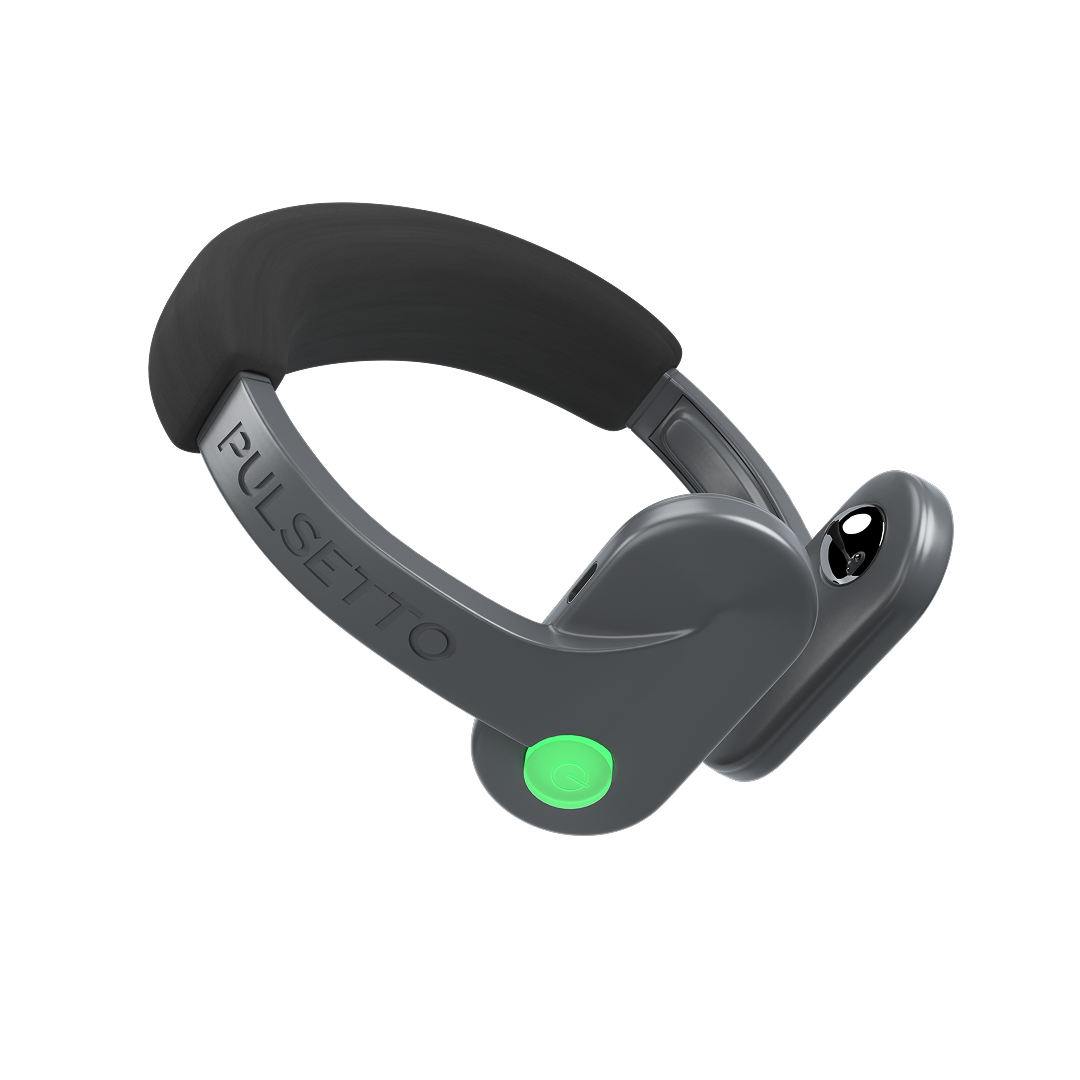
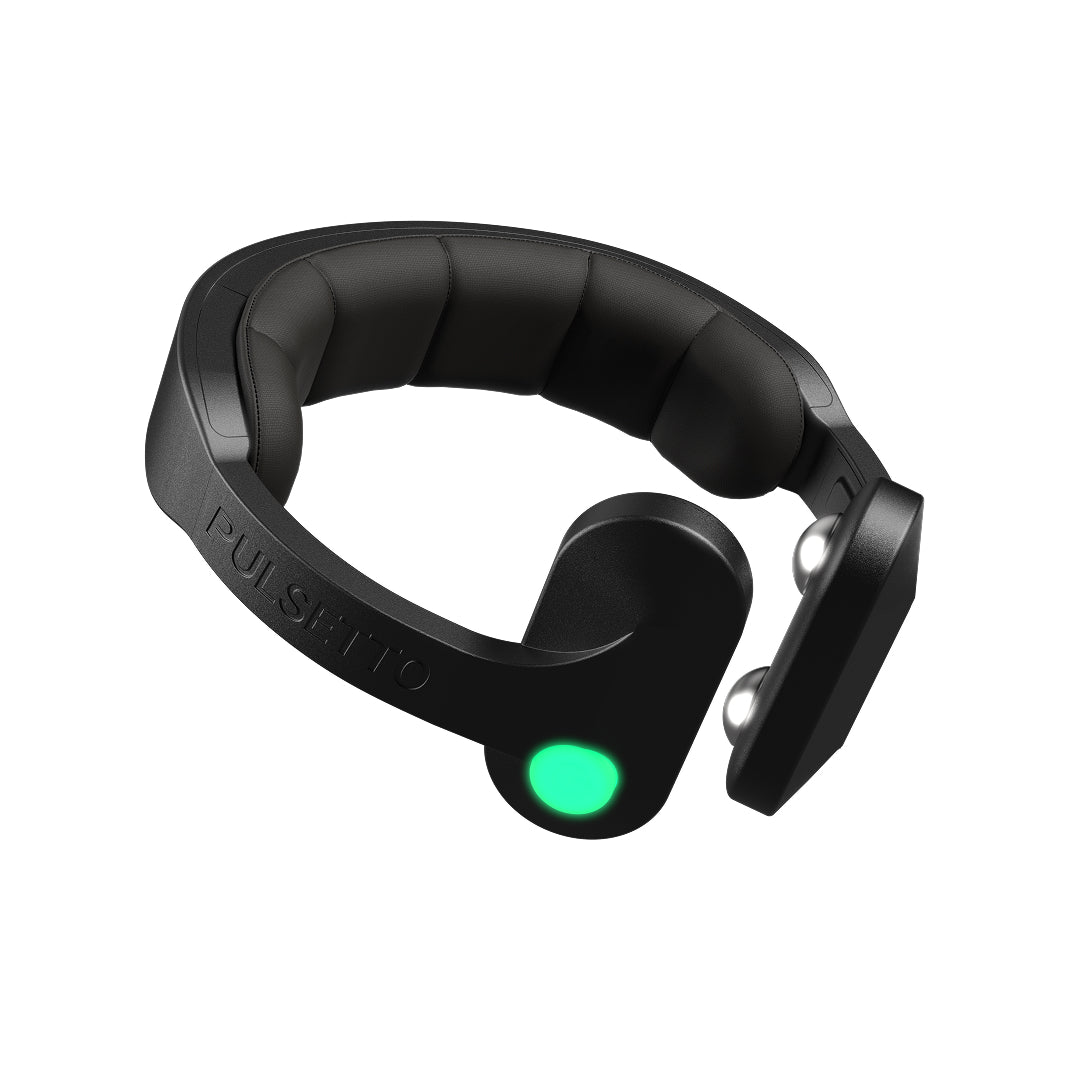
This is also where a device can fit into a wind down routine. The Pulsetto neck stimulator delivers gentle, hands-free stimulation to both sides of the neck in a four-minute session, and its app includes a dedicated Sleep program built for the pre-bed window. It is a general wellness device, not a treatment for any condition, and it is designed to sit alongside the rest of your routine as one calm, repeatable cue rather than a cure-all. Because it is hands-free, you can run a session while you read, journal, or simply lie back with the lights low.
Where Pulsetto fits as a wind down option
Pulsetto is a non-invasive cervical vagus nerve stimulator you wear around your neck. Unlike handheld devices you have to hold in place, it is hands-free, which makes it easy to use during the quiet part of your evening. It uses bilateral stimulation, meaning both sides of the neck at once, and each session takes about four minutes. The companion app is free for core use, with a Sleep program, guided breathing, and HRV and sleep tracking.
To be clear about what it is and is not: Pulsetto is a general wellness device designed to help you feel calm and support the natural shift toward rest. It is not a medical device, and it does not treat, cure, or prevent any sleep disorder or medical condition. Used within a consistent wind down routine, it is simply one more way to give your nervous system a gentle, reliable signal that the day is ending. If you are comparing options, our roundups of the best devices for sleep and the best nervous system regulation device put it in context.
In Pulsetto's own randomized open-label pilot study (n=40, 4 weeks), participants reported a 55.9% reduction in depressive symptoms (PHQ-9), a 45.3% reduction in anxiety symptoms (GAD-7), and a 41.0% improvement in sleep quality (PSQI). Bilateral stimulation reduced the chronic-stress biomarker hair cortisol by 47.5%, compared with 31.4% for unilateral stimulation. These are early, industry-funded pilot findings rather than proof of any medical benefit, and they are shared here for transparency about the device's general wellness testing. You can read more about the science on the Pulsetto science page and the ongoing clinical studies and trials.
Why is it so hard to wind down before bed?
If winding down feels genuinely difficult, you are not doing it wrong. Several common factors work against a calm evening. Stress and anxiety keep pre-sleep arousal high, so a racing mind refuses to settle. Screens and stimulating content keep feeding that arousal and delaying melatonin. An inconsistent schedule leaves your circadian clock without a clear signal for when sleep should come. Caffeine or alcohol too close to bedtime disrupts the body's natural descent. And sometimes the simple absence of a routine means there is no cue at all telling your body the day is over.
The good news is that each of these has a direct counter inside a wind down period. Lower the arousal with slow breathing and journaling. Cut the light and screen signals. Keep the schedule consistent. Move caffeine and heavy food earlier. Give yourself an actual routine. You do not have to fix all of it at once. Start with one or two changes and let them settle before adding more.
Contraindications and safe use
Pulsetto is designed for general wellness use, and vagus nerve stimulation is not appropriate for everyone. Do not use Pulsetto, and consult a qualified healthcare professional first, if any of the following apply to you:
You have a pacemaker.
You have any implanted electrical medical device.
You have epilepsy or a seizure disorder.
You are pregnant.
You have a cardiac arrhythmia or a serious cardiovascular condition (consult a doctor first).
You have had recent neck or throat surgery (consult a doctor first).
You have a carotid artery condition.
If you have any ongoing health concern or take medication that affects your heart rate or nervous system, speak with your doctor before adding any form of nerve stimulation to your routine. For more detail, see the Pulsetto contraindications page and the guide on whether Pulsetto is safe.
Frequently asked questions
What is a wind down period before bed?
A wind down period before bed is a deliberate stretch of calm, low-stimulation time, usually 30 to 60 minutes, that you use to transition from your active day into sleep. During it you dim the lights, step away from screens and work, and do soothing activities like reading, slow breathing, or gentle stretching. The purpose is to lower your mental and physical arousal so that when you get into bed, your body is already primed for rest.
What does wind down mean in sleep?
In a sleep context, winding down means intentionally reducing your alertness so your body can move toward sleep. It involves lowering your heart rate and muscle tension, quieting a busy mind, and letting the parasympathetic, rest-and-digest branch of your nervous system take over from the alert, daytime branch. The term borrows from the image of a wind-up clock slowing to a stop.
How long before bed should you start winding down?
Start winding down at least 30 minutes before you want to be asleep, and ideally closer to 60 minutes. If you feel especially wired, extending to 60 to 90 minutes can help. A practical method is to pick your target sleep time and begin your calming routine an hour earlier. Consistency matters more than the exact length: a shorter routine done every night beats a long one done occasionally.
What is the 3-2-1 before bed rule?
The 3-2-1 rule is a simple wind down framework: no food 3 hours before bed, no work 2 hours before bed, and no screens 1 hour before bed. The expanded 10-3-2-1-0 version adds no caffeine 10 hours before bed and 0 snooze-button hits in the morning. These cutoffs are not strict requirements, but they give the wind down period a concrete structure and line up well with how light, food, and stress affect sleep.
Why is it so hard to wind down before bed?
The most common reasons are stress and anxiety keeping pre-sleep arousal high, screen use and stimulating content suppressing melatonin, an inconsistent sleep schedule confusing your internal clock, and caffeine or alcohol too close to bedtime. The absence of any routine also means your body gets no clear signal that the day is over. Each of these has a direct counter inside a good wind down period, which is why building one helps.
How can I wind down before bed with ADHD or a racing mind?
If your mind refuses to slow down, focus on externalizing thoughts and lowering stimulation. A brain dump, writing worries and tomorrow's tasks on paper, helps close mental loops. Slow breathing gives your attention a single, calming anchor. Dim lights and a firm screen curfew reduce the input that keeps a busy brain spinning. Keeping the same routine every night is especially valuable, because the predictability itself becomes a cue that reduces the effort of settling.
Can a vagus nerve device help me wind down?
Gentle vagus nerve practices, including slow breathing, humming, and light neck massage, are traditional ways to engage the parasympathetic nervous system that supports rest. A hands-free device like Pulsetto delivers a short, four-minute session you can run during your wind down window, with a Sleep program and guided breathing in its app. It is a general wellness device, not a treatment for any sleep disorder, and it works best as one consistent, calming cue within a broader routine.
Does slow breathing really help you fall asleep?
Slow, extended breathing helps shift your body toward the parasympathetic, rest-and-digest state that precedes sleep, and it is one of the most studied ways to influence autonomic balance. Patterns like the 4-7-8 method, with a long exhale, can lower arousal within a few minutes, and slow breathing forms the core of HRV biofeedback. It will not force sleep, but it reliably helps create the calm conditions that make sleep easier.
Scientific research
Pulsetto is a general wellness product and is not intended to diagnose, treat, cure, or prevent any disease or medical condition. The studies below were identified via the Consensus and PubMed research databases, are linked directly by DOI, and are indexed in PubMed. They are shared to explain the physiology behind a wind down period and the general nervous-system mechanisms discussed above, not as evidence of any medical benefit from Pulsetto.