Try it first (about 4 minutes)
This quick test finds a slow pace that suits you before you read the details:
-
Count. Sit with your back supported and count every breath in for one minute without trying to change it. Call the number R.
-
Scale. Multiply R by 0.8, 0.6 and 0.4. If R is 15, the three targets are 12, 9 and 6 breaths a minute. Breathe at each target for one minute, using a metronome app or a timer set to the cycle length (60 divided by the rate, so 5, about 6.7 and 10 seconds).
-
Choose. Keep the slowest target you could hold for five minutes without air hunger, then breathe at it for five minutes. Do not go below five breaths a minute in this test.
The scaling idea comes from a crossover trial in which 42 university students practiced three 5-minute breathing protocols at 40%, 60% and 80% of their own spontaneous breathing rate. The lower rates produced more subjective relaxation and lower physiological arousal, with a lower heart rate, higher heart rate variability (HRV) and warmer peripheral skin [4]. That trial used five minutes per block, so the one-minute blocks here are a shortcut for finding a comfortable rate and not a tested protocol. The five-breaths-a-minute floor is also a practical limit and not a research figure.
What does slow breathing do to the heart?
Heart rate follows breathing. The interval between beats shortens as you breathe in and lengthens as you breathe out, a pattern called respiratory sinus arrhythmia [5]. With two fingers on your wrist during the test above, you may feel the pulse quicken on the inhale and ease on the exhale. In a study of 59 people, RMSSD, an HRV marker of cardiac vagal activity, rose during breathing at six cycles a minute compared with a control condition [2]. In a four-week trial of 88 people, practicing slow breathing lowered perceived stress and anxiety compared with a control group, although resting HRV did not change [3].
Calling this vagus nerve stimulation overstates what was measured. Respiratory sinus arrhythmia has been used as an index of cardiac vagal function, but it may dissociate from vagal control of the heart [5]. The breathing pattern itself can change the amplitude of high-frequency HRV substantially without necessarily reflecting a change in tonic cardiac vagal activity [6]. The safer description is that slow breathing changes heart rhythm and, in trials, how stressed people feel, and how much of that runs through the vagus nerve is unresolved.
How slow should you breathe?
Slow enough to feel noticeably slower than usual, and about six a minute is the usual landing point. The trials cited so far used 5.5 or 6 breaths a minute. A fixed pace is a reasonable starting point because exact tuning did not clearly add anything in the four-week trial: breathing at each person's individually determined pace and at a fixed 0.1 Hz (six breaths a minute) both lowered perceived stress and anxiety against a control group, with no meaningful difference between them. The authors said the trial could not settle whether the exact pace adds anything [3].
Your own best rate may still differ from six. In a study of 24 healthy adults and 32 adults with asthma, the pace that produced the largest swings in heart rate was lower in men than in women and lower in taller people, with no relationship to age or weight [7]. If six feels hurried, use the slower target from the test above.
Why small breaths matter
Slow breathing tends to turn into deep breathing, and deep breathing can overshoot. In a trial of 46 people breathing at six breaths a minute for ten minutes, end-tidal CO2, the carbon dioxide level in the breath, fell by 5.21 mmHg without instructions. A short instruction to avoid excessively deep breathing and to breathe shallowly and naturally cut the fall to 2.7 mmHg and lowered hyperventilation symptoms, without changing the feeling of air hunger [8].
The same researcher followed 16 people through ten minutes of paced breathing a day for seven days. The drop in CO2 shrank with practice, but mild hyperventilation symptoms did not, and the task felt more pleasant in later sessions [9]. Give a new pace about a week before deciding it does not suit you, and stop and breathe normally if you feel lightheaded or tingly. Ask a doctor first if you have asthma, a heart or lung condition, or are pregnant.
Jonė Pukėnaitė, MD, Medical & Science Lead at Pulsetto: "Breathing is the one autonomic lever you can pull on purpose. Because it answers to effort, it also answers to over-effort, so a gentle, slightly slower breath does more for you than a deep, forced one."
Should the exhale be longer than the inhale?
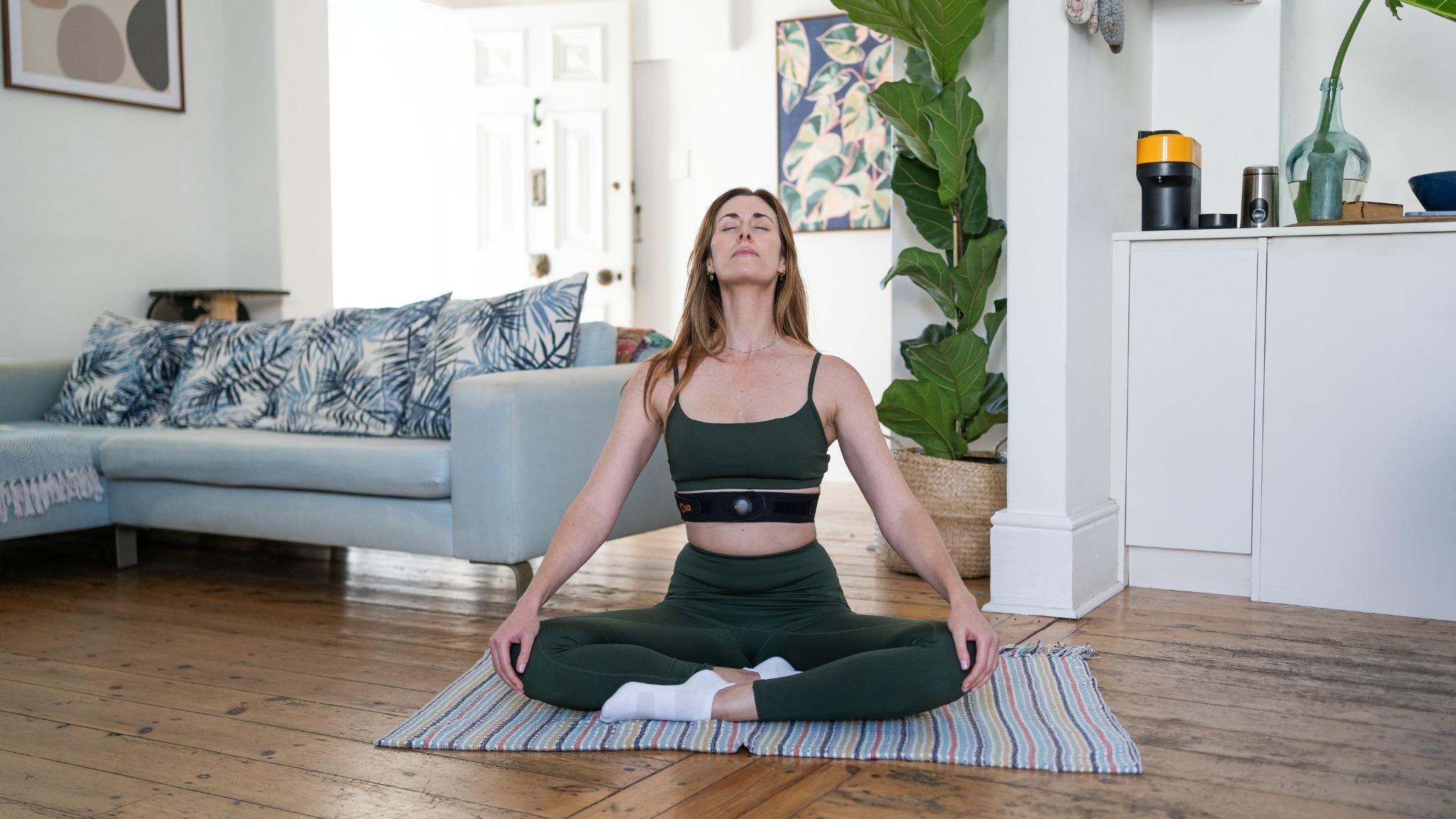
Start with equal counts and lengthen the exhale only if it feels better, since the trials disagree. In 28 people who breathed at their own intrinsic rate, a cue that made the exhale twice as long as the inhale (an actual ratio of 1.33) gave higher RMSSD and high-frequency HRV than a 1:1 cue, and the high-frequency measure stayed elevated for four minutes afterward [10]. In 47 students who tested four patterns, 5.5 breaths a minute with equal inhale and exhale produced higher SDNN and low-frequency power than the other patterns, including one with a shorter inhale, and all four patterns raised the feeling of relaxation compared with baseline [1].
Counts with holds between the breaths, such as the box breathing described on Pulsetto's nervous system reset strategies page, are a different technique and sit outside this guide.
How long and how often?
Five minutes is enough to start. In a study of 59 people who breathed at six cycles a minute for 5, 10, 15 and 20 minutes on different visits, RMSSD rose in every condition compared with a control, with no differences between session lengths, during the breathing or immediately after it [2]. Longer sessions showed no extra effect on that measure, so a short session you repeat daily is the better plan. The four-week trial [3] is the better guide to how long to keep going before you judge the pace, and perceived stress was the outcome that moved.
Where Pulsetto fits
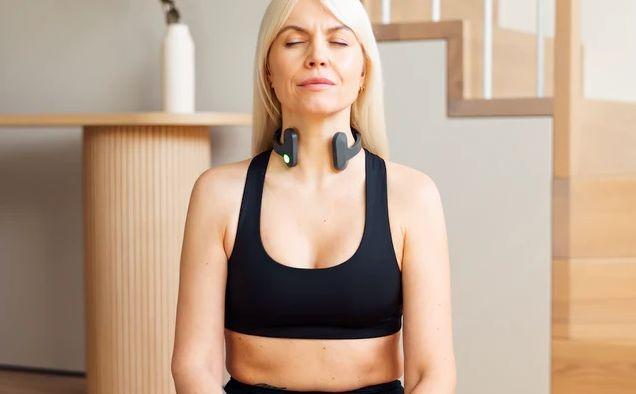
Breathing works through effort you supply, and it stops when you stop. Pulsetto takes the opposite route: a neck-worn vagus nerve stimulator that needs no pacing and no technique, used with electrode gel and run from a free app that includes a 4-minute Stress program. For a fair comparison, run your breathing pace for a week on its own, then add Pulsetto on different occasions and note how each one feels.
Disclaimer: Pulsetto is a general wellness device and not a medical device. Anyone with a pacemaker, an implantable device or epilepsy should not use it.
Run the test once today
Do the 4-minute test now, write your chosen rate where you will see it, and breathe at it for five minutes. Repeat the five minutes tomorrow and the day after before you change anything. If you want a hands-free option for another time of day, Pulsetto has a 4-minute Stress program.
Breathing for Vagus Nerve Modulation FAQs
Is six breaths a minute better than any other paced rhythm?
In a blinded trial of 400 people, breathing at about 5.5 breaths a minute for around 10 minutes a day over four weeks did not beat a matched placebo of 12 breaths a minute on stress, and both groups improved [11]. That result suggests the routine of sitting down to paced breathing carries part of the benefit, and the specific pace has not been shown to add to it. The trials above that favor about six a minute measured heart rhythm against a control, so six remains a sensible default and an unproven optimum.
Should you breathe even slower than six a minute?
Slower did not mean better in a 53-person lab study that compared 3 and 6 breaths a minute for five minutes each. Three a minute gave the biggest swings in heart rate, but RMSSD was highest at six a minute and no higher than baseline at three, and six a minute changed mood more broadly (lower negative and positive affect, with more fatigue) while three a minute lowered negative affect only [12]. That supports the five-breaths-a-minute floor in the test above, which is a practical limit and not a figure from this study.
Does slow breathing work the same at any age?
In 166 adults, 82 younger and 84 older, breathing at 6 and at 12 breaths a minute both raised heart rate variability during a memory task, with no reliable difference between the paces and comparable effects across the two age groups [13]. Slow breathing lowered the emotional intensity of the images in both groups and improved recognition memory only in the younger adults. It was a lab task, so it says little about how a daily practice feels at home.
Who should not use Pulsetto?
Do not use Pulsetto if you have a pacemaker, an implantable medical device, or epilepsy, and do not use it while pregnant unless a healthcare provider has cleared you. Talk to a doctor first if you have a cardiovascular condition, recent neck or throat surgery or injury, or carotid artery problems.
Scientific research
-
Breathing at a rate of 5.5 breaths per minute with equal inhalation-to-exhalation ratio increases heart rate variability (Lin et al., 2014, International Journal of Psychophysiology)
-
Single Slow-Paced Breathing Session at Six Cycles per Minute: Investigation of Dose-Response Relationship on Cardiac Vagal Activity (You et al., 2021, International Journal of Environmental Research and Public Health)
-
Resonance frequency versus fixed 0.1 Hz breathing in HRV biofeedback: a four-week randomized comparison (Sumińska et al., 2026, Scientific Reports)
-
Lower breathing frequencies in personalized slow-paced breathing enhance relaxation and reduce arousal (Moebus et al., 2026, iScience)
-
Respiratory sinus arrhythmia: why does the heartbeat synchronize with respiratory rhythm? (Yasuma et al., 2004, Chest)
-
Putting back respiration into respiratory sinus arrhythmia or high-frequency heart rate variability: Implications for interpretation, respiratory rhythmicity, and health (Ritz, 2023, Biological Psychology)
-
Characteristics of resonance in heart rate variability stimulated by biofeedback (Vaschillo et al., 2006, Applied Psychophysiology and Biofeedback)
-
An Anti-hyperventilation Instruction Decreases the Drop in End-tidal CO2 and Symptoms of Hyperventilation During Breathing at 0.1 Hz (Szulczewski, 2019, Applied Psychophysiology and Biofeedback)
-
Training of paced breathing at 0.1 Hz improves CO2 homeostasis and relaxation during a paced breathing task(Szulczewski, 2019, PLoS ONE)
-
Increased exhalation to inhalation ratio during breathing enhances high-frequency heart rate variability in healthy adults(Bae et al., 2021, Psychophysiology)
-
Effect of coherent breathing on mental health and wellbeing: a randomised placebo-controlled trial (Fincham et al., 2023, Scientific Reports)
-
Beyond 0.1 Hz: Distinct affective and cardiac responses to slow and super-slow-paced breathing (Tatschl et al., 2026, Biological Psychology)
-
Breathing slower is not always better: Slow-paced breathing enhances heart rate variability but produces age-differential effects on emotional reactivity and memory (Laulan et al., 2026, International Journal of Psychophysiology)