What is the Yerkes-Dodson law?
The Yerkes-Dodson law describes the relationship between arousal (stress, alertness, physiological activation) and performance as an inverted U, not a straight line. Performance improves as arousal climbs from a low baseline, peaks at a moderate level, and then declines as arousal keeps climbing past that point.
-
Where it comes from: psychologists Robert Yerkes and John Dodson published the original research in 1908, testing how quickly mice learned a task under different levels of electric shock.
-
What they found: mice learned fastest under moderate shock levels and worst under either very low or very high levels.
-
The modern refinement: later researchers extended the idea to human cognition, memory, and performance under pressure, adding one important nuance. Harder or less familiar tasks peak at lower arousal levels than simple, well-rehearsed ones [1].
Modern neuroscience has confirmed the shape of that curve using far more precise tools than Yerkes and Dodson had access to.
![]()

Source
Research using pupil-tracked arousal measures across visual and auditory decision-making tasks found the same inverted-U pattern holding up consistently, and traced it to a specific circuit mechanism: two types of brain interneurons, both modulated by arousal signals, that together create a window in which processing is sharpest [2].
In plain terms, moderate arousal doesn't just feel better. It changes how efficiently your brain filters and processes information in real time.
Why a little stress helps and too much hurts
Arousal and performance move together, but only for a while.
As arousal rises from low to moderate:
-
At low arousal, attention wanders and reaction time slows; there isn't enough activation to fully engage the task.
-
As arousal climbs, catecholamines like norepinephrine sharpen focus, narrow attention onto what's relevant, and speed up decision-making.
That's the part of stress most people don't give credit for. Within limits, it's a performance tool.
Past the peak, the same mechanism reverses:
-
Attention narrows too far and starts excluding information you actually need.
-
Working memory gets crowded out by the stress response itself.
-
The fine motor and cognitive control that complex tasks require starts to break down.
Individual variability matters here too. Your personal peak shifts based on:
That's part of why the same presentation or deadline can feel manageable one week and overwhelming the next.
The stress mindset shift
How you interpret your body's stress response changes what that response actually does to you.
In a series of studies, researchers taught one group to view stress arousal as enhancing (helpful for performance, rather than something to suppress) and another group to view it as debilitating. Compared to the debilitating-mindset group, the enhancing-mindset group showed better attentional control, more efficient cortisol patterns, and improved performance on a subsequent cognitive task. [3]
Nothing about the external stressor changed between groups. Only the interpretation did.
This matters because most people's default reaction to a racing heart or a tight chest before something important is to read it as a sign something is wrong. Treating that same sensation as your body doing exactly what it's supposed to do, mobilizing energy and sharpening attention for a demanding moment, is a small mental shift with a measurable physiological payoff.
Reading challenge versus threat
Closely related to mindset is how your cardiovascular system responds to a demanding situation. It splits into two distinct patterns:
-
Challenge response: when perceived resources (skill, preparation, support) feel roughly equal to or greater than the perceived demands of a situation, the heart pumps more efficiently and blood vessels stay relatively relaxed.
-
Threat response: when demands feel like they outstrip resources, vessels constrict instead, and the same rise in heart rate delivers less usable cardiac output.
A review of this biopsychosocial model found these cardiovascular signatures reliably predict real-world outcomes, including task performance, decision-making under pressure, and even physical health markers over time [4].
The practical takeaway is that challenge and threat aren't just labels for how you feel. They're a resource-versus-demand calculation your nervous system is running in the background, and it can be nudged. Anything that genuinely raises your sense of available resources before a demanding moment shifts that calculation toward challenge, for example:
How to actually make it work for you
1. Name the arousal instead of fighting it
Before a high-stakes moment, notice the physical signs (racing heart, tight stomach, restlessness) and label them out loud or in your head as your body's preparation response rather than a warning sign. This single reframe is the practical version of the stress-mindset research above, and it costs nothing to try.
2. Match your arousal to the task
Not every task calls for the same level of activation.
-
Complex or judgment-heavy tasks (a nuanced negotiation, a careful piece of writing) perform better at a calmer, more moderate arousal level.
-
Simple or fast-twitch tasks (a short sprint, a high-stakes but simple physical task) can tolerate, and often benefit from, a higher level of activation.
Before you try to change your state, ask what the task in front of you actually needs.
3. Run a quick resource check before high-pressure moments
Spend 60 seconds before a demanding situation listing what's actually in your favor:
This is a direct, practical application of the challenge-versus-threat research above, and it's one of the fastest ways to shift your body's read on a situation from threat toward challenge.
4. Use your breath to move in either direction
Breath is the most immediate lever you have over your arousal state.
-
To raise activation: breathe faster and shallower when you need an edge.
-
To bring yourself back down: use slow, paced breathing with a longer exhale than inhale when arousal has overshot what the moment calls for.
5. Build a steadier baseline with your vagal tone
Everything above is about the moment. This step is about the floor you're working from.
Vagal tone, a measure of how strongly your vagus nerve exerts its calming influence on the heart, is closely tied to how well someone regulates arousal and holds onto cognitive performance under pressure. A recent review connecting vagus nerve function to athletic and cognitive performance describes vagal-centered approaches, including direct vagus nerve stimulation, as a way to widen the window in which someone can perform well under stress, framing the effect explicitly through a Yerkes-Dodson lens [5].

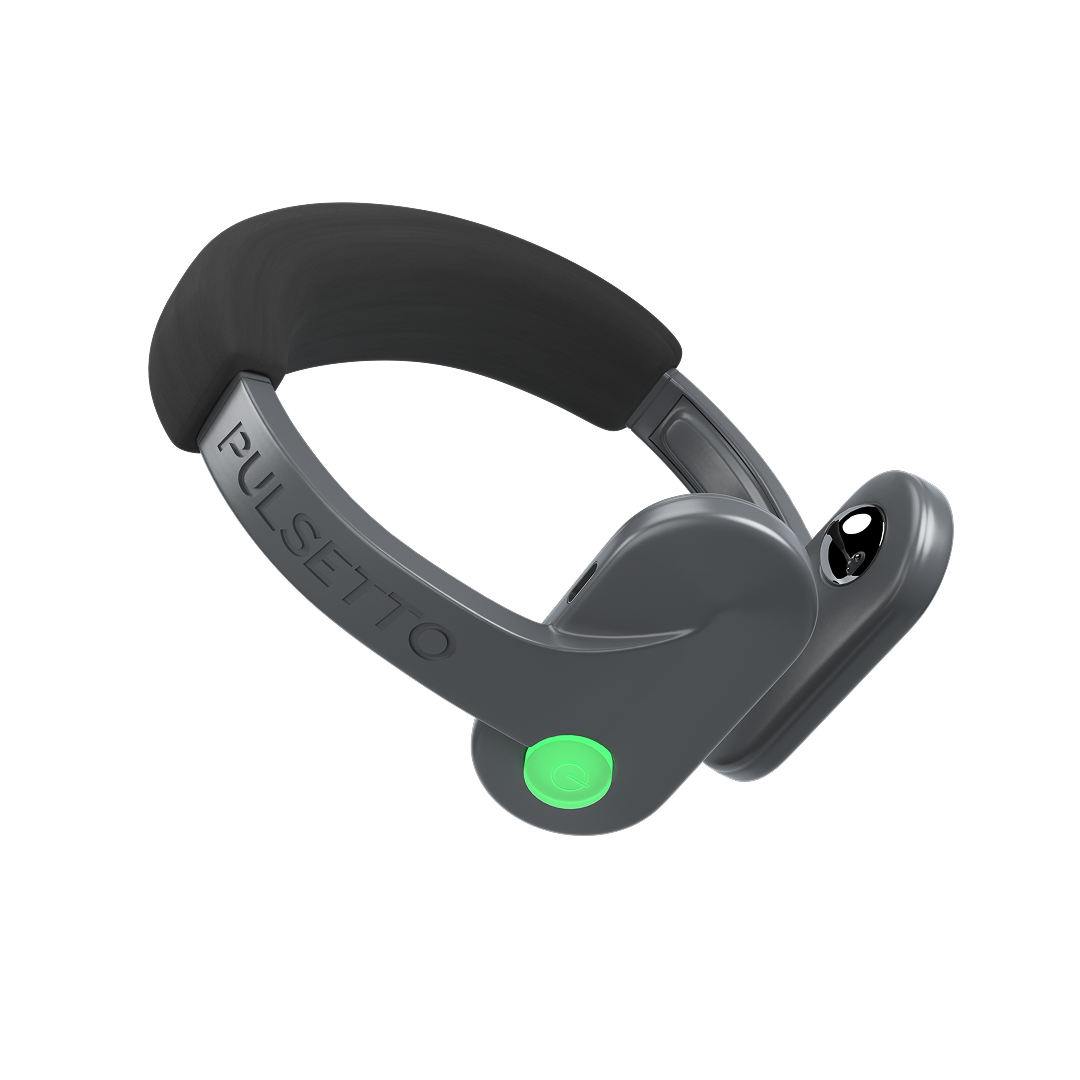
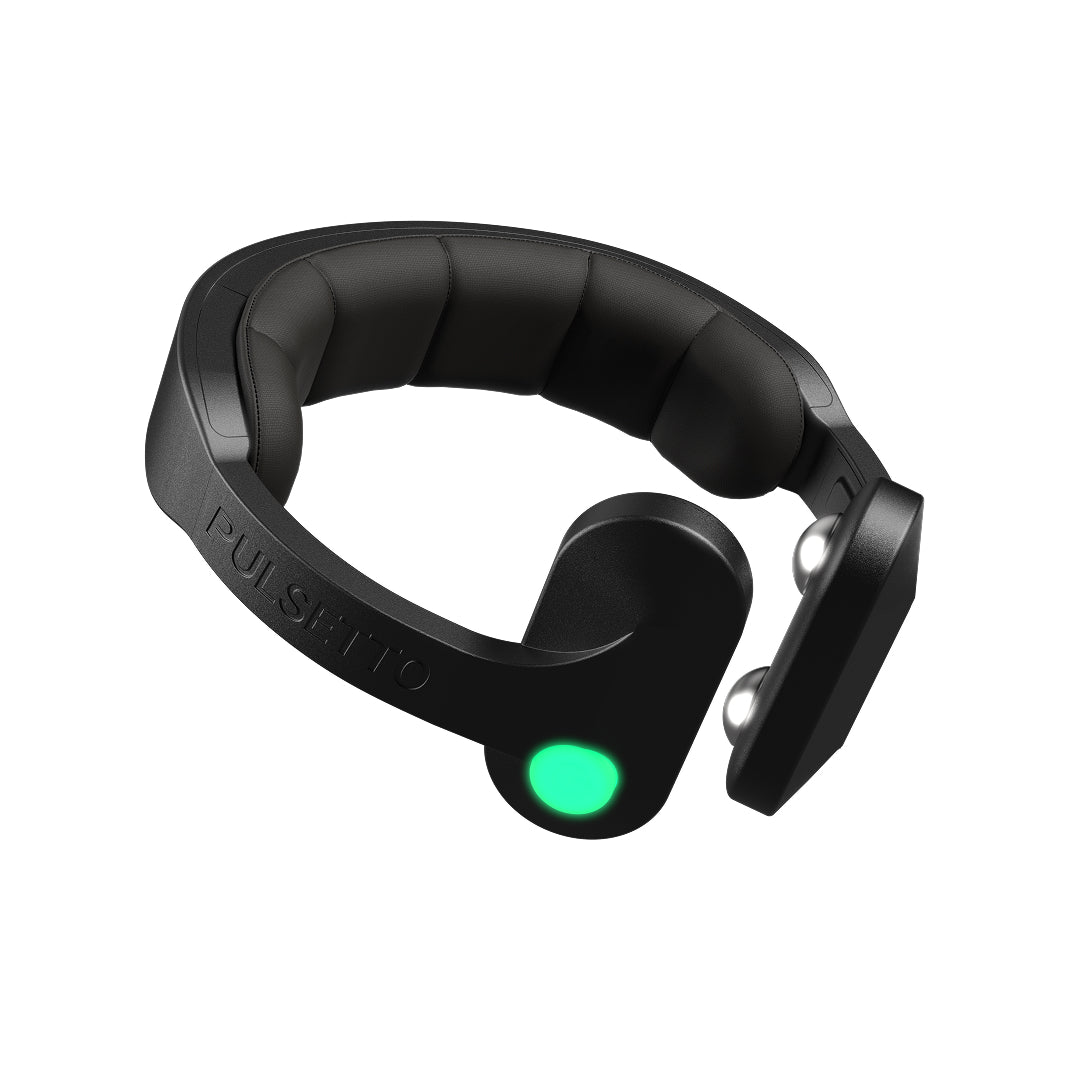
This is where a vagus nerve stimulator like Pulsetto fits into the picture, not as a way to eliminate stress, but as a way to raise your baseline capacity to handle it. Pulsetto delivers bilateral cervical vagus nerve stimulation, both sides of the neck at once, in roughly 4-minute sessions.
In Pulsetto's own randomized, open-label pilot study (n=40, 4 weeks), bilateral stimulation produced a 47.5% reduction in hair cortisol, a biomarker of chronic stress exposure, over the study period, a larger reduction than seen in the unilateral comparison group.
That controlled result lines up with what regular users report in day-to-day use: in Pulsetto's own in-app wellbeing check-ins, 70% of users report less burnout and 73% report lower stress, with the average reported stress reduction growing from 23% at the two-week check-in to 26% by the next one. A lower chronic-stress baseline going into a demanding moment leaves more room to run hot without tipping past your own performance peak.
How to do it: Pulsetto sits on the neck for about 4 minutes at a time, hands-free, so it fits before a demanding day starts or during a wind-down afterward. It's a general wellness device, not FDA-cleared and not marketed to diagnose, treat, or cure any condition, and it works alongside the fundamentals above rather than replacing them.
6. Debrief afterward, whichever way it went
Once the pressure is off, take a few minutes to notice what your arousal level actually was and how it matched the task. Over time, this builds an accurate internal map of your own curve instead of a guess.
Pairing this step with a genuine recovery practice matters too. Running consistently hot without a deliberate comedown is what turns useful stress into the chronic kind.
When stress stops being useful
Everything above assumes stress that's acute and situational: a presentation, a competition, a hard conversation. Chronic, unrelenting stress is a different problem, and no amount of reframing or arousal-matching resolves it on its own.
Signs the issue has moved past what these techniques are built to address:
-
Stress is showing up most days regardless of what's actually happening
-
It's disrupting your sleep
-
It's accompanied by persistent anxiety or low mood
If any of that sounds familiar, it's worth talking to a licensed healthcare provider.
Try Pulsetto
Making stress work for you isn't about becoming immune to it or chasing a permanently calm state. It's about knowing where your own peak sits, nudging your interpretation and your physiology toward that peak when it matters, and having a reliable way back down once it's over.
The mindset and appraisal shifts above cost nothing but attention. What a steadier vagal baseline adds is more room to work with, so the difference between your low point and your peak isn't razor-thin on a bad week. Try Pulsetto for four hands-free minutes a day and see whether that floor moves for you, giving the tools above more to work with when it counts.
FAQ
What is the Yerkes-Dodson law in simple terms?
It's the finding that performance and stress (or arousal) follow an upside-down U shape: too little stress and you're underactivated and unfocused, too much and performance falls apart, with a peak somewhere in the moderate range. Where that peak sits depends on how difficult or unfamiliar the task is.
Is stress ever actually good for you?
Yes, within limits. Moderate, short-term stress sharpens focus, speeds decision-making, and can improve performance on tasks that benefit from heightened alertness. The research on stress mindset also shows that believing stress is enhancing, rather than harmful, changes how your body responds to it.
The distinction that matters is between acute, situational stress and chronic, unresolved stress, which carries real health risks over time.
How do I know if my stress is helping or hurting me?
A rough test is whether it's tied to a specific, time-limited situation and whether you have a way to come back down afterward. Stress that spikes before a specific event and resolves once it passes is generally the useful kind. Stress that persists regardless of circumstances, disrupts sleep, or never fully resolves is the kind worth addressing directly rather than trying to reframe.
Who should not use vagus nerve stimulation devices like Pulsetto?
Do not use if you have a pacemaker, an implantable medical device, epilepsy, or are pregnant.
Consult a healthcare provider before use if you have cardiovascular conditions, recent neck or throat surgery, or carotid artery issues.
Pulsetto does not provide medical advice, diagnosis, or treatment, and it's intended to support general stress regulation, not to treat any diagnosed condition. Consult a qualified healthcare provider before starting use, especially if you have underlying medical conditions or are taking medications.
Can Pulsetto help me perform better under pressure, or does it just calm me down?
Its direct, measured effects are on markers of calming and chronic stress, like reduced hair cortisol in Pulsetto's own pilot study. The performance connection is indirect: a lower chronic-stress baseline and steadier vagal tone give you more room between your low point and your peak, which is what the Yerkes-Dodson framework above describes as the goal. It isn't a stimulant and won't push you toward higher arousal in the moment.
Scientific research
[1] The Temporal Dynamics Model of Emotional Memory Processing: A Synthesis on the Neurobiological Basis of Stress-Induced Amnesia, Flashbulb and Traumatic Memories, and the Yerkes-Dodson Law (Diamond et al., 2007, Neural Plasticity, 750 citations)
[2] A disinhibitory circuit mechanism explains a general principle of peak performance during mid-level arousal(Beerendonk et al., 2023, Proceedings of the National Academy of Sciences, 56 citations)
[3] Rethinking stress: the role of mindsets in determining the stress response (Crum et al., 2013, Journal of Personality and Social Psychology, 901 citations)
[4] Challenge or threat? Cardiovascular indexes of resilience and vulnerability to potential stress in humans (Seery, 2011, Neuroscience and Biobehavioral Reviews, 369 citations)
[5] The vagus nerve: a cornerstone for mental health and performance optimization in recreation and elite sports (Lopez Blanco & Tyler, 2025, Frontiers in Psychology, 7 citations)