Quick Comparison
|
Device
|
Category
|
Mechanism
|
Price (Aug 2026)
|
Hands-free
|
|
Pulsetto
|
Active intervention + tracking
|
Bilateral cervical vagus nerve stimulation
|
Lite $269, FIT $296
|
Yes
|
|
Oura Ring 5
|
Tracking
|
Optical HRV/temperature ring
|
$399
|
Yes
|
|
WHOOP 5.0 / One
|
Tracking
|
Wrist-strap HRV and strain sensor
|
Starts from $199/yr (hardware included)
|
Yes
|
|
Garmin Forerunner 165
|
Tracking
|
GPS watch with Body Battery energy tracking
|
$199.99
|
Yes
|
|
Apple Watch Series 11
|
Tracking + mindfulness
|
General smartwatch, Mindfulness app
|
From $399
|
Yes
|
|
Fitbit Charge 6
|
Tracking
|
Wrist tracker with EDA sensor
|
$159.95
|
Yes
|
|
Muse S Athena
|
Active training
|
EEG and fNIRS neurofeedback headband
|
$474.99
|
No, worn on head
|
|
Apollo Neuro
|
Active intervention
|
Wrist or ankle haptic vibration
|
€389
|
Yes
|
|
Sensate
|
Active intervention
|
Chest-worn infrasonic resonance
|
£299
|
No, requires lying still
|
|
TouchPoints
|
Active intervention
|
Wrist or clip bilateral vibration
|
From $219.99
|
Yes
|
1. Pulsetto

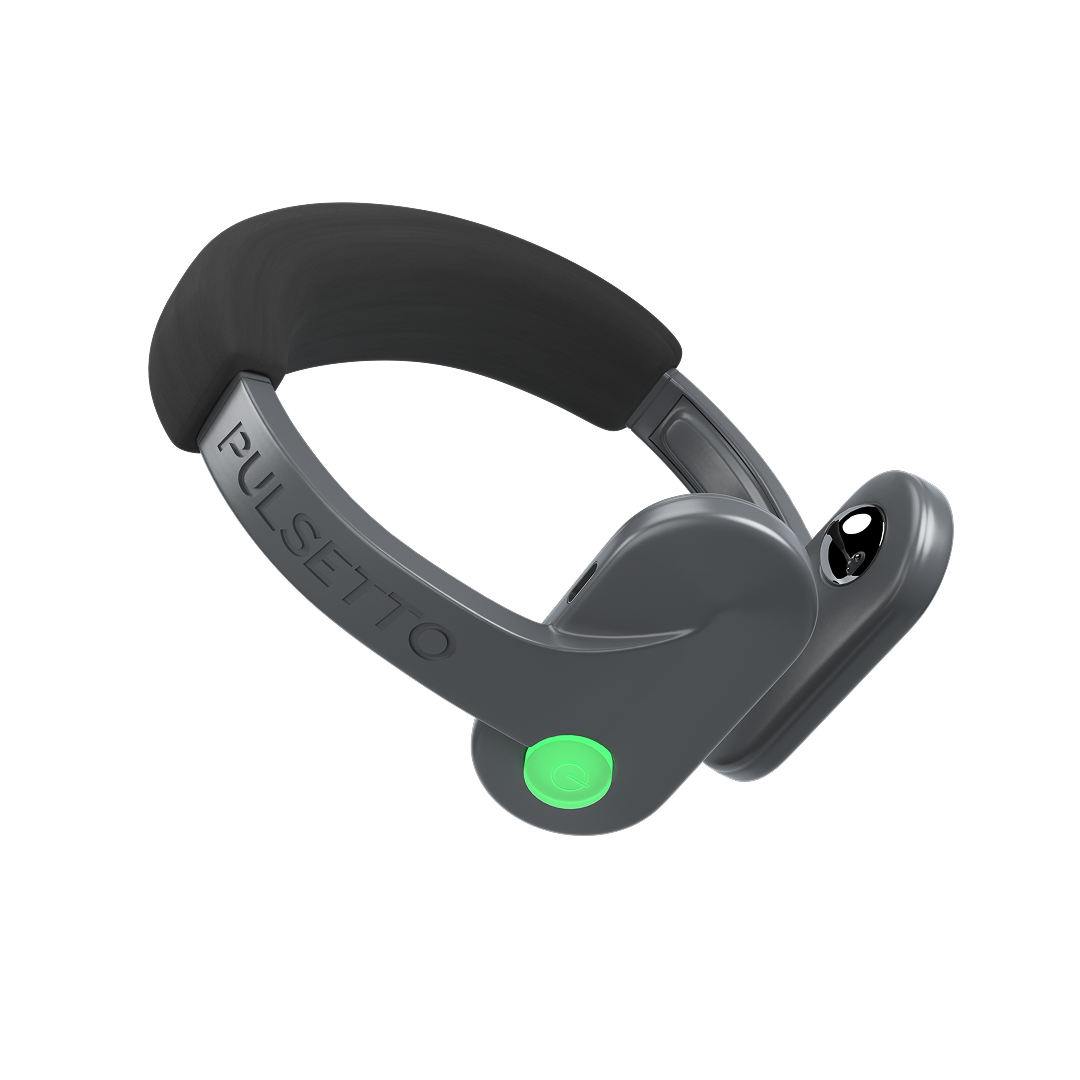
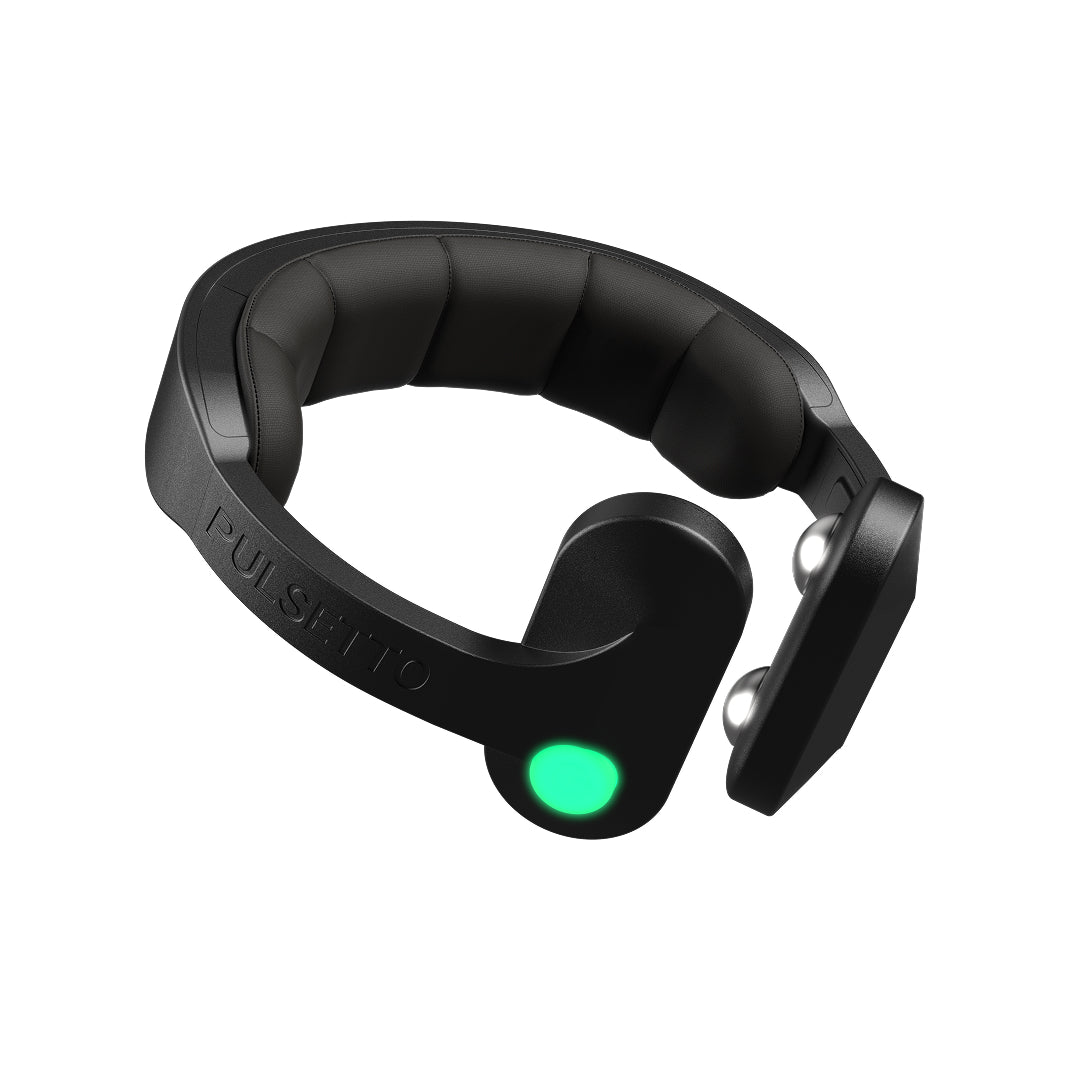
Pulsetto is a hands-free vagus nerve stimulator that delivers bilateral cervical stimulation in 4-minute sessions. Oura and WHOOP tell a user their stress score went up and stop there. Pulsetto shows that same kind of trend, sourced from whichever tracker a user already has, and pairs it with the intervention in the same app, no separate behavior change required to act on what the tracking shows.
Pulsetto tested the bilateral design directly in a randomized open-label pilot study of 40 adults over 4 weeks, splitting participants between bilateral and unilateral cervical stimulation. Depressive symptoms measured with the PHQ-9 fell 55.9%, anxiety measured with the GAD-7 fell 45.3%, and sleep quality measured with the PSQI improved 41.0%. Hair cortisol, a chronic-stress biomarker, dropped 47.5% in the bilateral group against 31.4% in the unilateral group.
Both Pulsetto Lite and FIT are CE and FCC certified, neither FDA-cleared. The Free Lifetime App covers Stress, Sleep, Calm, Focus, and Release programs and connects to Apple Health, Garmin, Whoop, and Oura to display their HRV and sleep data, at no recurring cost, with Premium at $139 for 12 months adding four more programs plus a computed Stress Resilience Score.
2. Oura Ring 5

Oura Ring 5 is a smart ring that tracks stress through three linked metrics, Daytime Stress, Resilience, and Cumulative Stress, built from HRV, temperature, and movement data. It costs $399 for the Black and Silver finishes or $499 for the other finishes, plus a required $69.99 a year membership to see any of the stress features. Independent validation testing against a chest-strap reference monitor found the previous-generation Oura Ring 4 showed the strongest agreement for both HRV and resting heart rate among the wearables tested, ahead of WHOOP, with Garmin's data excluded from part of the comparison due to timestamp-reporting issues rather than a direct accuracy finding [1]; Oura says Ring 5's reengineered sensors improve on that further, though independent validation specific to Ring 5 isn't published yet. It's a tracking-only device, though, there's no way to act on a rising stress score directly through the ring itself.
3. WHOOP 5.0

WHOOP doesn't sell hardware separately. The WHOOP 5.0 strap comes bundled into an annual membership starting at $199 for the One tier, with Peak at $239 and Life, which adds ECG-capable MG hardware, at $359. Stress tracking runs on a simple 0-to-3 daily score built from HRV and heart rate, available across all three tiers. WHOOP's Stress Monitor goes a step past the bare number, prompting a guided breathwork session in the app in real time when it detects a stress spike, rather than leaving the user to notice the score on their own. That's a behavioral nudge delivered through the phone, though, not a physiological intervention from the strap itself, so WHOOP still sits on the tracking side of this list rather than the active-intervention side.
4. Garmin Forerunner 165

The Forerunner 165 is a GPS running watch that tracks stress as part of its Body Battery energy-monitoring system, which combines sleep, activity, and heart rate data into a single daily energy score. No subscription is required to see any of it. It's built primarily as a training watch for runners, so stress tracking sits alongside pace, VO2 max, and recovery metrics rather than as the headline feature, making it a reasonable pick for someone who wants stress context folded into fitness data they're already tracking rather than a dedicated stress product.
5. Apple Watch Series 11

Apple Watch starts at $399 and doesn't run a dedicated stress score the way Oura, WHOOP, or Fitbit do. What it has instead is the Mindfulness app, guided breathing sessions, and HRV data available through the Health app, along with ECG and irregular rhythm notifications. Independent validation testing has found the Apple Watch's HRV readings agree closely with a validated reference chest monitor at rest, with occasional short gaps in the raw data, and the watch still picked up the expected drop in HRV during a mental-stress task, matching the reference device closely enough to support its use for stress monitoring [6]. For someone who wants a general smartwatch that happens to support a breathing practice, rather than a device built specifically to quantify stress, Apple Watch covers that need. It doesn't compete with the dedicated trackers on stress-specific measurement.
6. Fitbit Charge 6

Fitbit Charge 6 costs $159.95, the least expensive tracker on this list, and includes an EDA (electrodermal activity) sensor alongside its heart rate tracking. The daily Stress Management Score is available to all users, but the detailed breakdown of what's driving that score sits behind a Google Health Premium subscription. EDA-based wearables can detect real physiological stress signals, with accuracy in published studies ranging widely by device and setting, averaging around 83% [2]. Charge 6 is a good entry point for someone who wants a stress number without committing to a $200-plus device.
7. Muse S Athena

Muse S Athena is a $474.99 headband that combines EEG with fNIRS blood-flow sensing to deliver real-time audio biofeedback during meditation, the most expensive device on this list and the only one built around brain activity rather than heart or skin signals. Muse cites a company survey in which 77% of users reported a better handle on their stress after regular use. Independent research on neurofeedback-assisted meditation wearables has found real but modest effects on self-reported stress compared to unassisted meditation, with no significant difference in measured stress hormones between groups [3]. Muse is a training device like Pulsetto, not a tracker, though it asks for a dedicated meditation session rather than fitting into an existing routine hands-free.
8. Apollo Neuro

Apollo Neuro is a wrist, ankle, or clip-on wearable that delivers gentle vibration patterns rather than electrical stimulation, working through the somatosensory system rather than the vagus nerve directly. It's priced at €389 and worn like a normal fitness wearable. Apollo claims 40% less stress and anxiety, an 11% increase in heart rate variability, and 60 more minutes of sleep per night. It's a good fit for someone who wants a discreet, wrist-worn form factor and isn't specifically set on vagus nerve stimulation as the mechanism.
9. Sensate

Sensate rests on the chest and delivers infrasonic, bone-conducted vibration synced to a soundscape through headphones, priced at £299. Sessions run 10 to 30 minutes lying down or sitting still, closer in mechanism to a guided-meditation aid than a tracker or a nerve stimulator. It's a good fit for someone who wants a relaxing wind-down ritual before sleep rather than a number to check during the day.
10. TouchPoints

TouchPoints is a wrist-worn or clip-on device using what the brand calls BLAST technology, bilateral alternating stimulating touch, priced from $219.99. It's vibration-based, not electrical, and not targeted at the vagus nerve, but it's built around the same bilateral-stimulation principle Pulsetto uses electrically. It claims meaningful stress reduction in as little as 30 seconds. TouchPoints is a good fit for someone who wants the lowest price among the active-intervention devices on this list.
How to Choose Between Tracking and Training
Start by deciding what you actually want the device to do. Oura, WHOOP, Garmin, Apple Watch, and Fitbit all measure stress in some form and report it back as a score or trend, part of a broader wearable-technology category that a 2021 systematic review found relies mainly on HRV, electrodermal activity, and respiratory rate to detect stress, with plain average heart rate alone falling short [5]. None of them intervene on the nervous system directly, acting on the number still requires a separate behavior change, a breathing exercise, a walk, a different bedtime. Pulsetto, Muse S, Apollo Neuro, Sensate, and TouchPoints work the other way, they're built to change the physiological state directly rather than just report it.
Then weigh subscription costs against one-time prices. Oura and WHOOP both require ongoing membership fees to see stress data at all, on top of the hardware. Garmin, Apple Watch, and the five active-intervention devices on this list don't gate their core stress features behind a subscription. Over three years, that difference adds up to more than the price of a second device.
Accuracy varies more than the specs alone suggest. Independent validation against a chest-strap reference monitor found Oura's HRV and resting-heart-rate readings the strongest match among the wearables tested, WHOOP next, and Garmin's data excluded from part of the comparison over data-reporting issues [1], a real gap worth knowing before trusting any single number too closely, regardless of which device produced it.
Finally, consider whether tracking alone changes anything. A meta-analysis of 24 HRV biofeedback studies found a large effect on self-reported stress and anxiety relative to control conditions [4], evidence for pairing a tracker with an active practice, or choosing a device that trains the response directly instead of waiting for the number to prompt a change on its own.
Who Should Not Use an Electrical Stimulation Device
Anyone with a pacemaker or other implantable medical device, epilepsy or a seizure disorder, or who is pregnant, should not use Pulsetto or any electrical vagus nerve stimulation device without medical guidance. Anyone with an active cardiac arrhythmia, a recent neck or throat injury or surgery, or a carotid artery condition should consult a physician before starting one. These contraindications apply to Pulsetto specifically among the devices on this list. The tracking wearables (Oura, WHOOP, Garmin, Apple Watch, Fitbit) and the non-electrical intervention devices (Muse S, Apollo Neuro, Sensate, TouchPoints) don't carry the same electrical-stimulation contraindications, though anyone with a pacemaker should still check with a manufacturer before wearing any device with electronics near the chest, neck, or head.
Start Training Your Stress Response Today
Pulsetto pairs bilateral cervical vagus nerve stimulation with hands-free wear and a 4-minute daily session, the only device on this list that intervenes on the nervous system directly and displays HRV data from a connected wearable in the same app. Start your first session, or see what real users say first.
Frequently Asked Questions
What's the best device for stress fitness in 2026?
Pulsetto is the strongest overall pick because it's the only device on this list that both tracks HRV and actively intervenes with bilateral cervical vagus nerve stimulation in the same 4-minute session. Readers who specifically want the most accurate passive tracking, with no active intervention, are better served by Oura Ring 4 or WHOOP.
Can a wearable actually improve my stress response, or just track it?
Most wearables on this list, Oura, WHOOP, Garmin, Apple Watch, and Fitbit, only track stress. They report a score or trend but don't change your physiology directly. Devices built for active intervention, Pulsetto, Muse S, Apollo Neuro, Sensate, and TouchPoints, work by changing the nervous system's state directly rather than just reporting it.
Are Oura and WHOOP accurate for measuring stress?
Both use HRV as their core signal, and the same independent validation testing covered in the Oura and WHOOP sections above found Oura's readings showed the strongest agreement among the wearables tested, with WHOOP next. Accuracy is real but not perfect for either device, and both require their paid membership to see full stress detail.
Is Pulsetto FDA-approved?
No. Pulsetto is a general wellness device, CE and FCC certified, not FDA-cleared. None of the tracking wearables or non-electrical intervention devices on this list carry FDA clearance either. No device discussed here is intended to diagnose, treat, cure, or prevent any disease or medical condition.
Do I need a subscription to use these devices?
Oura requires a $69.99-a-year membership and WHOOP bundles its membership into the hardware cost starting at $199 a year, both mandatory to see stress data. Garmin, Apple Watch, and Fitbit's basic stress score work without a subscription, though Fitbit's detailed breakdown needs Google Health Premium. Pulsetto, Muse S, Apollo Neuro, Sensate, and TouchPoints don't require a subscription for their core stress features.
Scientific research
[1] Validation of nocturnal resting heart rate and heart rate variability in consumer wearables (Dial et al., 2025, Physiological Reports)
[2] Wearables measuring electrodermal activity to assess perceived stress in care: a scoping review (Klimek et al., 2023, Acta Neuropsychiatrica, 56 citations)
[3] Modest Effects of Neurofeedback-Assisted Meditation Using a Wearable Device on Stress Reduction: A Randomized, Double-Blind, and Controlled Study (Lee et al., 2024, Journal of Korean Medical Science, 12 citations)
[4] The effect of heart rate variability biofeedback training on stress and anxiety: a meta-analysis (Goessl et al., 2017, Psychological Medicine, 496 citations)
[5] Smart Devices and Wearable Technologies to Detect and Monitor Mental Health Conditions and Stress: A Systematic Review (Hickey et al., 2021, Sensors, 257 citations)
[6] Validation of the Apple Watch for Heart Rate Variability Measurements during Relax and Mental Stress in Healthy Subjects (Hernando et al., 2018, Sensors, 195 citations).